EDMOND OPTICS 66-509 Square Optical Breadboard Top 125MM
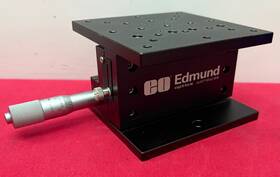
( Brand: Edmond Optics ), ( Manufacturer Part Number: 66-509 ), ( Model: MODEL MAYBE 66-509 UNSURE ), ( Type: Linear Positioner/stage ), ( Country Of Origin: China )
Review EDMOND OPTICS Metric Z stage 125mm Square Optical Breadboard Top
The **Edmund Optics 66-509 Z-Stage with 125mm Square Optical Breadboard Top** is a precision-engineered optical mounting platform designed for high-accuracy alignment and positioning in demanding optical, laser, and scientific applications. This versatile system combines a robust, stable breadboard base with a finely adjustable vertical translation stage, providing researchers, engineers, and technicians with the flexibility to fine-tune optical components with micrometer-level precision. The **125mm square optical breadboard top**, crafted from high-quality aluminum, offers a flat, rigid surface with a **T-slot pattern** that accommodates a wide range of optical mounts, kinematic clamps, post holders, and other modular components, ensuring secure and repeatable positioning. The **Z-stage itself** features a **micrometer-driven vertical adjustment mechanism**, allowing for smooth, incremental movement in the Z-axis with a resolution as fine as **0.001 mm (1 m)**, making it ideal for critical applications such as laser alignment, interferometry, microscopy, or any setup requiring precise axial positioning. The stage s **smooth, low-friction design** minimizes backlash and drift, while its **durable construction** ensures long-term stability under repeated adjustments. Whether used as a standalone alignment tool or integrated into a larger optical breadboard system, this Z-stage enhances the precision and repeatability of optical experiments, reducing setup time and improving experimental accuracy. Its compatibility with standard optical mounts and modular components further expands its utility, making it a valuable addition to any optics laboratory or research facility.
The **Edmund Optics 66-509 Z-stage 125mm Square Optical Breadboard Top** is a versatile component for optical experiments, alignment, and precision optical assembly. Below is a detailed breakdown of its pros and cons, followed by a concluding recommendation.
---
### **Pros**
1. **Precision and Stability**
The breadboard top is designed for optical experiments, offering a flat, stable surface with minimal warping. The Z-stage allows for fine vertical adjustments, which is essential for aligning optical components like lenses, mirrors, or beam splitters. The precision-machined surface ensures consistent performance in critical applications.
2. **Compatibility with Optical Systems**
The 125mm square size is a standard dimension in optical labs, making it easy to integrate with other Edmund Optics components (e.g., mounts, kinematic mirrors, or translation stages). The breadboard top can be paired with the included Z-stage (or additional stages) to create a modular setup.
3. **Versatility for Alignment**
The Z-stage provides independent vertical movement, which is useful for:- Fine-tuning the position of optical elements.
- Compensating for slight misalignments in beam paths.
- Adjusting focus or beam height without disturbing horizontal alignment.
This is particularly valuable in experiments requiring precise beam steering or interferometry.
4. **Modular and Expandable**
The breadboard top can be mounted on a larger optical table (e.g., Edmund Optics 600mm x 1200mm breadboard) or used as a standalone platform. The Z-stage can be combined with other Edmund Optics stages (e.g., XY translation stages) to create a multi-axis adjustment system.
5. **Durability and Build Quality**
Edmund Optics products are generally known for their robustness. The breadboard top is likely made from aluminum or a similar material, providing durability and resistance to thermal expansion. The Z-stage features a lead screw mechanism, which is reliable for fine adjustments.
6. **Cost-Effective for Basic Needs**
Compared to custom optical tables or high-end alignment systems, this breadboard top and Z-stage offer a cost-effective solution for hobbyists, students, or small labs. It strikes a balance between affordability and functionality for entry-to-mid-level optical work.
7. **Easy to Use**
The Z-stage is manually operated, which means no power supply or complex controls are required. This makes it accessible for users without advanced technical skills. The design is intuitive, with a knurled knob for precise adjustments.
---
### **Cons**
1. **Limited Travel Range**
The Z-stage s vertical travel range is likely limited (typically a few millimeters, depending on the exact model). For applications requiring large vertical adjustments (e.g., focusing over a wide range or accommodating bulky optics), this may be insufficient. Users may need to stack multiple stages or use additional translation stages.
2. **Manual Adjustment Only**
The Z-stage relies on manual operation, which can be time-consuming for repetitive adjustments. In high-throughput experiments or automated setups, motorized stages would be more efficient. However, for most manual alignment tasks, this is not a significant drawback.
3. **No Built-In Locking Mechanism**
Some Z-stages lack a locking feature to secure the position after adjustment. While the 66-509 may have a friction mechanism to hold the stage in place, it s not always as secure as a clamp or locking screw. Users may need to apply additional pressure or use external locking mechanisms.
4. **Size Constraints**
The 125mm square size is compact, which limits the number of optical components that can be placed on it simultaneously. For larger experiments or those requiring multiple stages, a bigger breadboard (e.g., 300mm x 600mm) would be more practical. The breadboard top itself is designed to be mounted on a larger base, but the working area is still limited.
5. **Potential for Vibrations**
If mounted on an unstable surface (e.g., a wobbly optical table or a non-damped platform), the breadboard top and Z-stage may be susceptible to vibrations. This could affect sensitive experiments, such as interferometry or low-light imaging. A high-quality optical table with damping is recommended for critical applications.
6. **Compatibility with Non-Standard Components**
While the breadboard top is compatible with most standard Edmund Optics mounts, it may not fit non-standard or custom optics perfectly. Users with unique requirements may need to design custom adapters or mounts.
7. **Wear Over Time**
Like any mechanical stage, the lead screw and guide rails of the Z-stage may experience wear with frequent use. While Edmund Optics products are generally durable, prolonged use could lead to slight backlash or reduced precision, requiring occasional maintenance or recalibration.
---
### **Conclusion**
The **Edmund Optics 66-509 Z-stage 125mm Square Optical Breadboard Top** is a practical and affordable choice for users who need a compact, stable platform for basic to intermediate optical alignment tasks. Its strengths lie in its precision, modularity, and ease of use, making it ideal for educational settings, hobbyist projects, or small-scale research where space and budget are constraints. The Z-stage s fine vertical adjustments are particularly useful for focusing, beam steering, or compensating for minor misalignments.
However, its limitations such as the limited travel range, manual operation, and compact size make it less suitable for large-scale experiments, automated systems, or applications requiring extensive vertical movement. Users with more demanding needs may need to supplement it with additional stages or a larger breadboard.
---
### **Recommendation**
**Buy the Edmund Optics 66-509 if:**- You are a student, hobbyist, or small lab working on basic optical experiments (e.g., beam alignment, simple interferometry, or educational demos).
- You need a compact, stable platform for fine vertical adjustments without breaking the bank.
- You plan to integrate it with other Edmund Optics components (e.g., mounts, translation stages) for a modular setup.
- Your experiments do not require extensive vertical travel or automated adjustments.
**Consider alternatives if:**- You need a larger working area (opt for a bigger breadboard, e.g., 300mm x 600mm).
- Your experiments require motorized or automated stages (look for motorized Z-stages or piezo actuators).
- You anticipate heavy use or need a longer lifespan (invest in higher-end stages with locking mechanisms or anti-backlash features).
- You work with bulky optics or require large vertical adjustments (combine this with additional translation stages or a taller breadboard).
For most users on a budget or with modest needs, the **66-509 is a solid choice** that offers good value for its intended purpose. Pair it with a stable optical table and complementary components to maximize its utility.
Details:
Medical Micro tech Raider Technology,mm BT by Metro CAD Used Equipment, Manufacturing Device and Industrial Equipment SQUARE OPTICAL BREADBOARD TOP. Sold as is, where is. ALUMINIM STAGE, model # MAYBE 66-509 UNSURE, ITEM IS USED AND SHOWS COSMETIC WEAR model # UNSURE YOU ARE ONLY PURCHASING WHAT PICTURED PLEASE REVIEW PICTURES CAREFULLY RULER NOT INCLUDED IN SALE, MCID 100792. Certain pieces of equipment may contain residual chemicals.
8808 Monticello Lane North. EDMOND OPTICS METRIC Z-STAGE 125mm x SQUARE OPTICAL BREADBOARD TOP.
part #: 66509 price
- $175.00
specifications linactuat:
- brand: Edmond Optics
- mpn: 66-509
- model: Model Maybe 66-509 Unsure
- type: Linear Positioner/stage
- country of origin: China
offer linactuat:
- best offers: True
- availability: In Stock
- sold: 0
- options: Ship-to-home
- quantity: 1
- started: February 17, 2026
general linactuat:
- Industrial Automation Motion Controls > Rotary Linear Motion > XY Rotary Positioning Stages
- condition: Used
payments linactuat:
- wallet: Google-pay
- credit card: Discover
- other
shipping linactuat:
- type: Calculated
- carrier: UPS, USPS
- transit: 2-4 Days
- class: Standard, Expedited
- cost: $17.09
- service: UPS Ground, USPS Ground Advantage, USPS Priority Mail
returns linactuat:
- policy: No Returns
seller linactuat:
- city: Osseo, Minnesota
- # reviews: 3780
- rating: 99.8%