NEWPORT 8354 Focus Piezo Actuator Picomotor Travel Thread New 12.7MM 1/4-40
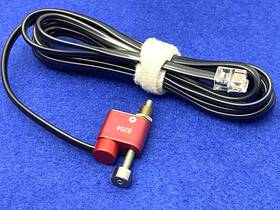
( Brand: Newport ), ( Manufacturer Part Number: 8354 ), ( Part Type: Actuator )
Review NEWPORT New Focus Piezo Actuator Picomotor 12.7mm Travel 1/4-40 Thread
The **Newport 8354 Focus Piezo Actuator** is a high-precision, ultra-compact positioning system engineered for demanding applications where sub-nanometer resolution and exceptional stability are critical. Part of Newport s renowned **PICMOTOR** series, this actuator combines the power of piezoelectric ceramic technology with a robust mechanical design to deliver smooth, repeatable motion over a **12.7mm (0.5-inch) travel range**, making it ideal for fine focusing, alignment, and sample positioning in optical systems, microscopy, spectroscopy, and other precision instrumentation. The **1/4-40 thread** mounting interface ensures seamless integration into existing setups, whether for laboratory benches, automated research platforms, or industrial metrology systems. Unlike traditional motorized stages, the PICMOTOR leverages **piezoelectric actuation**, eliminating backlash, hysteresis, and mechanical wear while achieving **nanometer-level precision** with minimal settling time. Its **closed-loop control** capability, when paired with Newport s advanced drivers, ensures consistent performance even under dynamic conditions, making it suitable for applications requiring high-speed scanning, vibration isolation, or long-term stability. The actuator s **compact footprint** and **low-profile design** minimize interference with surrounding optics or components, while its **durable construction** featuring corrosion-resistant materials and precise machining ensures reliability in both cleanroom and harsh-environment applications. Whether used for **confocal microscopy**, **laser alignment**, **interferometry**, or **automated sample handling**, the 8354 delivers the precision and reliability needed to push the boundaries of scientific and industrial measurement. Newport s reputation for innovation and engineering excellence is reflected in this actuator s ability to seamlessly transition from prototyping to high-volume production, offering researchers and engineers a turnkey solution for their most exacting positioning challenges.
The Newport 8354 Focus Piezo Actuator with a 12.7mm travel range and 1/4-40 thread is a high-precision positioning device commonly used in optics, microscopy, and other scientific applications. Below is a detailed analysis of its pros and cons, followed by a conclusion and recommendation.
---
### **Pros**
1. **High Precision and Resolution**
The actuator uses piezoelectric technology, which provides sub-nanometer resolution and repeatability. This makes it ideal for applications requiring fine adjustments, such as focusing in microscopy or aligning optical components.
2. **Fast Response Time**
Piezoelectric actuators respond almost instantaneously to voltage changes, enabling rapid positioning without mechanical inertia. This is beneficial for dynamic applications where speed is critical.
3. **Compact and Lightweight Design**
The 12.7mm travel range is achieved in a relatively small form factor, making it suitable for space-constrained systems. Its lightweight nature reduces the load on mounting structures.
4. **High Stiffness and Rigidity**
Piezo actuators are inherently stiff, minimizing vibrations and drift. This is crucial for maintaining stability in sensitive measurements or imaging applications.
5. **No Moving Mechanical Parts (Beyond Piezo Stack)**
Unlike traditional motorized stages, this actuator has no gears, belts, or motors, reducing wear and tear and extending its operational lifespan with proper use.
6. **Compatibility with Newport s Ecosystem**
The 1/4-40 thread is a standard in optics and lab equipment, allowing easy integration with Newport s other components (e.g., mounts, kinematic bases, or controllers). It also works with third-party adapters for broader compatibility.
7. **Low Power Consumption**
Piezo actuators draw minimal power during operation, making them energy-efficient for continuous or long-duration use.
8. **Durability Under Static Loads**
When not actively moving, the actuator can hold a position with minimal power (via "hold voltage"), reducing energy use and maintaining stability.
9. **Wide Temperature Range (With Proper Care)**
While piezoelectric materials can degrade at extreme temperatures, this actuator is designed to operate reliably within a moderate range (typically -20 C to 60 C), depending on the specific model and usage conditions.
10. **Minimal Backlash**
Unlike motorized stages with gears, piezo actuators eliminate backlash entirely, ensuring precise and consistent positioning.
---
### **Cons**
1. **Limited Travel Range**
The 12.7mm travel is relatively short compared to motorized stages, which may offer travel ranges of centimeters or more. This could be a limitation for applications requiring larger adjustments.
2. **Creep and Drift Over Time**
Piezoelectric materials can exhibit slow, unintended displacement ("creep") due to internal stress relaxation or environmental factors (e.g., humidity, temperature fluctuations). While this is often negligible for short-term use, it may accumulate over long periods or in unstable environments.
3. **Sensitivity to Voltage and Environmental Factors**
Piezo actuators require precise voltage control for accurate positioning. Fluctuations in power supply or environmental changes (e.g., temperature, humidity) can affect performance. A stable power source and controlled environment are often necessary.
4. **No Built-In Limit Switches or Hard Stops**
Unlike motorized stages, this actuator lacks physical limit switches or mechanical stops. Overshooting the travel range can damage the actuator or the connected components. External sensors or software limits are required to prevent this.
5. **Requires a Controller or Driver**
Direct voltage application is not recommended; instead, a dedicated piezo controller (e.g., Newport s 8300 series or third-party options) is needed to manage positioning, feedback, and safety. This adds complexity and cost.
6. **Cost**
High-precision piezo actuators are generally more expensive than motorized alternatives, especially when factoring in the cost of a compatible controller and additional hardware (e.g., sensors, amplifiers).
7. **Potential for Degradation Over Time**
Piezoelectric materials can degrade due to repeated cycling, thermal stress, or electrical overloading. While durable, they have a finite lifespan, particularly under harsh conditions.
8. **Not Suitable for Heavy Loads**
While stiff, piezo actuators have limited force capacity. Overloading can cause permanent deformation or failure. The Newport 8354 is designed for lightweight optical components, not heavy mechanical loads.
9. **Learning Curve for Integration**
Proper calibration, driver configuration, and environmental control are often required for optimal performance. Users unfamiliar with piezo technology may face challenges in setup and troubleshooting.
10. **Limited Compatibility with Non-Newport Systems**
While the 1/4-40 thread is standard, other integration points (e.g., electrical connectors, mounting interfaces) may require custom adapters or modifications for non-Newport equipment.
---
### **Conclusion**
The Newport 8354 Focus Piezo Actuator is an excellent choice for applications demanding **ultra-high precision, speed, and stiffness** in a compact form factor. Its lack of moving parts, sub-nanometer resolution, and compatibility with optical systems make it ideal for **microscopy, laser alignment, interferometry, and other lab-based precision tasks**. However, its **limited travel range, sensitivity to environmental factors, and requirement for external control hardware** may pose challenges for users needing larger adjustments or robust, hands-off operation.
For applications where **cost, simplicity, or larger travel ranges** are prioritized over sub-nanometer precision, motorized stages (e.g., linear or rotary stages with encoders) might be more suitable. Conversely, if **fine focusing, vibration-free operation, or dynamic adjustments** are critical, the Newport 8354 is a strong contender provided the user is willing to invest in proper control systems and environmental management.
---
### **Recommendation**
**Buy the Newport 8354 if:**- You require **sub-nanometer precision** for optical alignment, microscopy, or interferometry.
- Your application benefits from **fast, vibration-free positioning** in a compact space.
- You are willing to integrate it with a **dedicated piezo controller** (e.g., Newport 8300 series) and ensure a **stable environmental and electrical setup**.
- The **12.7mm travel range** is sufficient for your needs (consider stacking multiple actuators for larger ranges if necessary).
**Avoid or consider alternatives if:**- You need **larger travel ranges** (e.g., >20mm) or **heavy-duty positioning**.
- Your application lacks **controlled environmental conditions** (e.g., temperature/humidity fluctuations).
- You prefer **plug-and-play simplicity** without requiring additional controllers or calibration.
- Budget constraints make the **higher upfront cost** prohibitive compared to motorized stages.
**Alternative Considerations:**- For **larger travel ranges**, pair this actuator with a motorized coarse stage or use multiple piezo actuators in series.
- For **simpler setups**, evaluate motorized focusers (e.g., Thorlabs or Zaber stages) with encoder feedback.
- For **ultra-high stability**, pair the piezo actuator with a **closed-loop system** (e.g., capacitive or optical feedback) to mitigate creep.
In summary, the Newport 8354 is a **premium tool for precision applications** but requires careful implementation to fully realize its potential. For most lab-based optical or microscopy tasks where fine control is paramount, it is a worthwhile investment.
Details:
part #: 8354 prices
- $149.99-$400.00
specifications linactuat:
- brand: Newport
- mpn: 8354
- part type: Actuator
general linactuat:
- condition: Used
- Industrial Automation Motion Controls > Rotary Linear Motion > Linear Actuators
returns linactuat:
- paid by: Seller
- time: 30 Days
- method: Money back
- policy: Returns Accepted
payments linactuat:
- other
- credit card: Visa
- wallet: Apple-pay
offer linactuat:
- started: April 21, 2026
- availability: In Stock
- options: Ship-to-home
- quantity: 1
- sold: 0
shipping linactuat:
- cost: $7.00
- service: USPS Ground Advantage
- class: Standard
- carrier: USPS
- type: Fixed
- transit: 3-8 Days
seller linactuat:
- rating: 99.8%
- city: Gilroy, California
- # reviews: 8496
Newport 8354 Is Similar To:
- 460a Xyz Newport Nrc Axis Stage Positioner New (19.8% similar) It is new in the original packaging. This is a Newport model 460A XS three axis positioned...(March 1st, 2018)
- 481-a Newport Rotation Stage Brand New In Original Box (29.5% similar) 2MM load CAPACITY178 n SENSITIVITY30 arc SECGRADUATIONS1 VERNIER5 min thread TYPE8-32 and 1/4 20OPTIC DIAMETER25. The outer stage is a high resolution, tangentially driven design. 9 NM WEIGHT0. Scale markings indicating every degree and a vernier with 5 arc min are engraved on the side of stage. 1MM...(September 22nd, 2018)
- 850-05 Newport Nrc Actuator 850b-05sh (39.3% similar) Thus, selling as is. This is a used Newport NRC actuator, model no 05SH. It was surplussed from a working lab environment, but condition unknown...(November 7th, 2017)
- 850-85sh Newport Corp Actuator Model (39.6% similar) All statements regarding products and their configurations are made to the best of our ability with assumption that buyer is knowledgeable proficient in use this type equipment. Reach out to us...(August 30th, 2017)
- 850-a Newport Motorized Precision Actuator (37.6% similar) Location: FDR Newport 850-A motorized precision actuator with case physical condition: used, but in good condition, item does power up no other testing has been done...(August 15th, 2017)
- 850a-05 Newport Motorized Precision Linear Motion Actuator (33.1% similar) It comes with a 14 day guarantee against being DOA from receipt. Always here to help. Newport 850A-05 motorized precision linear motion actuator 850AQUESTIONS. Here : this lot is for one. Orders are shipped to the cardholders billing address. Warranty this item is guaranteed to be as described. ...(September 28th, 2018)
- 850b-1-hs Newport 1-inch Travel Linear (33.6% similar) Save packaging for carrier claim. Please by sending a message through or calling. DOA stands for dead on arrival, meaning that the item did not function properly when it arrived. All parts, accessories, cables, etc. Our contact: Rodney Wang SC asset management, inc. All pictures are taken in house. ...(July 10th, 2017)
- 9401 Newport Great Rotary Mount Stage Optical Waveplate Polarizer Thread (39.5% similar) Resolution with a built-in vernier scale. Lightly used Newport 9401 rotary mount stage for 1 wave plates or polarizes with 8-32 mounting thread condition: this item is but in excellent condition. Lockable with setscrews. To prevent accidental misalignment, simply remove the lever from stage. Stored ...(January 11th, 2019)
- Cma-25cc Newport Motorized Linear Actuator Range (35.8% similar) This actuator can be used with Newport 861 controller not included or equivalent. Tested, fully functional, and in excellent condition. Used Newport CMA-25CC motorized linear actuator, 25MM travel range with an audio jack connector and cable...(September 22nd, 2018)
- C132037 8801 8601 Umr3.5 Umr5.16 Umr8.25 New Focus Newport Power Technology Multi-axis Laser Optics Micrometer Picomotor Optical Positioner (32.7% similar) No software, power cords, or other accessories are included unless stated above. Approximate overall unpacked dimensions 15 l x 11 w x 11. To to this laser optical positioning assembly features a pair of power technology, inc. The new focus driver and power adapter both power up, and their power ...(September 22nd, 2016)
- Gts150 Newport New Gts High Precision Linear Stage Mm Travel Load (45.7% similar) Product series overview high-precision GTS motorized linear stages technical specs travel RANGE150MM maximum SPEED50MM minimum incremental MOTION0. Featuring anti-creep crossed roller bearings via geared retainers, a high-torque dc motor, and low friction ball screw, GTS150 is capable of precise, ...(April 23rd, 2018)