THORLABS M-433 Newport Optomechanical Linear Translation 801234291086 Stages
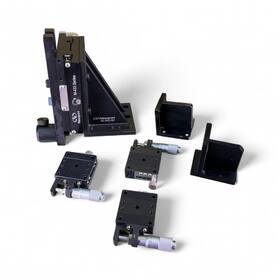
( Brand: Thorlabs ), ( Manufacturer Part Number: M-433 ), ( Type: Linear Positioner/stage ), ( UPC: 801234291086 )
Review THORLABS Newport Assorted Optomechanical Linear Translation Stages See Desc
Thorlabs Newport M-433 Optomechanical Linear Translation Stages - Precision Positioning for Demanding Applications
The Thorlabs Newport M-433 Optomechanical Linear Translation Stages are a remarkable addition to any lab or research environment, offering unparalleled precision and reliability for a wide range of applications. These stages are designed to deliver smooth, repeatable, and accurate linear motion, making them an essential tool for scientists, engineers, and technicians seeking superior performance in their optomechanical systems.
The M-433 stages feature a high-quality, durable design, constructed with anodized aluminum for enhanced durability and resistance to corrosion. The stages boast a travel range of 33 mm, providing ample room for adjustments in various experimental setups. The linear motion is achieved through a ball screw drive mechanism, which offers low-friction operation and exceptional load capacity, making it suitable for heavy payloads.
A key advantage of the M-433 stages is their high resolution and accuracy. With a linear encoder integrated into the design, these stages can achieve positioning accuracy of 1.5 m, ensuring precise alignment and repeatability of movements. The encoder also allows for real-time feedback, enabling closed-loop control systems for even greater control and precision.
The M-433 stages are compatible with a variety of mounting options, including standard dovetail and C-mount interfaces, making them versatile and easy to integrate into existing systems. Additionally, they come equipped with a digital controller that allows for easy setup and operation, with adjustable parameters for velocity, acceleration, and positioning.
In summary, the Thorlabs Newport M-433 Optomechanical Linear Translation Stages are a powerful, high-performance solution for demanding linear motion applications in the optomechanical field. Their precise, smooth, and repeatable motion, coupled with their high load capacity and compatibility with various mounting options, make them an indispensable tool for any lab or research environment seeking superior performance and reliability.
Thorlabs Newport M-433 Optomechanical Linear Translation Stages are precision positioning devices designed for various applications, including microscopy, spectroscopy, and precision engineering. Here are the pros and cons of purchasing these stages:
Pros:1. High Precision: The M-433 stages offer excellent linear repeatability of 1.5 microns and low hysteresis, making them suitable for demanding applications requiring precise positioning.
2. Large Travel Range: With a travel range of 50mm, these stages can accommodate a wide variety of samples or components.
3. Low Vibration: The M-433 stages are designed with a low vibration resonance mode, minimizing unwanted vibrations that could interfere with sensitive measurements.
4. Easy Integration: These stages come with an integrated Z-axis adjustment knob and a removable stage top plate, making them easy to integrate into various systems.
5. Durable Construction: The M-433 stages are built with high-quality materials and a robust design, ensuring long-term reliability and durability.
Cons:1. Cost: The M-433 stages are premium products and may be expensive compared to other linear translation stages on the market.
2. Size: With a length of 100mm and a width of 50mm, these stages may take up a significant amount of space in your experimental setup.
3. Requires Careful Handling: Due to their precision and high-quality construction, the M-433 stages require careful handling to avoid damaging them.
4. Limited Speed: While the M-433 stages offer precise positioning, they may not be suitable for applications requiring high-speed motion.
In conclusion, the Thorlabs Newport M-433 Optomechanical Linear Translation Stages are excellent choices for applications that require high precision, low vibration, and a large travel range. However, their cost, size, and limited speed may be potential drawbacks for some users. If you have the budget and space, and your application requires the features offered by these stages, they are highly recommended. For cost-sensitive applications or those requiring high-speed motion, you may want to consider alternative translation stages available on the market.
Details:
The micrometer heads display some wear. On one of the 40mm translation stages, a locking knob is sheared off. Units come from a functional environment. This optomechanical equipment provides precise positioning and alignment, featuring micrometer-driven single-axis translation for various optical setups laboratory experiments.
part #: m433 prices
- $169.15-$1450.00
specifications linactuat:
- brand: Thorlabs
- mpn: M-433
- type: Linear Positioner/stage
- upc: 801234291086
offer linactuat:
- sold: 0
- best offers: True
- quantity: 1
- started: December 18, 2025
- availability: In Stock
- options: Ship-to-home
shipping linactuat:
- cost: $0.00
- transit: 4-8 Days
- carrier: UPS, FedEx
- type: Fixed
- class: Standard
- service: UPS Ground, FedEx Ground / FedEx Home Delivery
seller linactuat:
- # reviews: 1188
- rating: 99.9%
- city: Fairfield, California
payments linactuat:
- credit card: Discover
- wallet: Apple-pay
- other
general linactuat:
- Industrial Automation Motion Controls > Rotary Linear Motion > XY Rotary Positioning Stages
- condition: Used
returns linactuat:
- paid by: Buyer
- policy: Returns Accepted
- method: Money back
- time: 30 Days
Thorlabs M-433 Is Similar To:
- 360-90 Ap90 Newport And Thorlabs (29.6% similar) One newport angle bracket, rigid 90 angled mounting plate with slotted face sand Thorlabs AP90 taped holes. Used in very good conditioning lot of 2 PCs...(November 1st, 2017)
- Thorlabs Nfl5d m 5 Mm Travel Translation Stage With Differential Drive Metric (47.5% similar) Privacy: rest assured your information will not be given, sold, rented or loaned to any third party. If a custom power cord or ac adapter is required for the item, it only included if pictured described above. Unless pictured, no power adapter / cable included. Item was recently removed from working...(April 30th, 2024)
- Thorlabs Lnr25zfs 25mm Stepper Motor Translation Stage Crossed Roller Bearings (46% similar) This item has been evaluated for condition and function in accordance with R2V3 requirements. 30-DAY warranty. If an accessory is not specifically mentioned, it included. Good used condition. Please inquire for shipping charges all other locations and/or combined. Averred will not guarantee to the ...(May 3rd, 2024)
- Thorlabs Xr25p 25 Mm Travel Linear Translation Stage Side-mounted Micrometer (57.9% similar) This unit will arrive in the condition shown. Warranty this item is guaranteed to be as described. Shipping buyer pays for all shipping costs. Thorlabs XR25P 25MM travel linear translation stage side-mounted micrometer: this lot is for one Thorlabs travel linear translation stage, side-mounted ...(August 2nd, 2024)
- Thorlabs Lnr50se m Lnr50p1 m 50 Mm Travelmax Translation Stage M6 Encoded Drv014 (45.4% similar) Power cords and power adapters are never included unless specifically mentioned. This unit will arrive in the condition shown. Connectors still have original wrapping from Thorlabs present. Warranty this item is guaranteed to be as described. Orders are shipped to the cardholders billing address. ...(August 5th, 2024)
- Thorlabs Nrt150 150 Mm Motorized Linear Translation Stage Stepper Motor 1 4 Inch 20 (59.9% similar) Load capacity. 150MM travel range. Horizontal: 44 lbs. Power cords and power adapters are never included unless specifically mentioned. These controllers are compatible with Genesis and apt software, which supply out-of-the-box stage control from a pc enables support for common programming ...(August 6th, 2024)
- Thorlabs Xr25c Pt1-z8 25 Mm 0.98 Inch One-axis Motorized Translation Stage (49.1% similar) The Thorlabs XR25C model is known for its exceptional performance and durability, making it a top pick businesses industries in need of reliable motorized translation stage. With a 25MM 0.98 one-axis design, it offers precise and efficient performance, making an excellent choice for those in need of...(August 13th, 2024)
- Thorlabs Mts25 m-z8 Motorized Linear Translation Stage 25mm Range (59.5% similar) Thorlabs MTS25/M-Z8 motorized linear translation stage. Horizontal loads of 25 lbs 12 kg and vertical 10 4.5 are supported by the 67.49:1 planetary gear head. Thorlabs' MTS25-Z8 MTS25/M-Z8 motorized translation stage provides 25MM 0.98 of electronically controlled linear travel along a well-defined ...(August 24th, 2024)
- Oriel 16021 Linear Translation Stage X Axis 3 Inch 3.5 And Thorlabs Micrometer 13mm (38.6% similar) This unit will arrive in the condition shown. Power cords and power adapters are never included unless specifically mentioned. 3 x 3.5 1/2 travel and Thorlabs 13MM micrometer. Oriel 16021 linear translation stage x axis 3/3 .5 Thorlabs micrometer 13MM: this lot is for one oriel linear translation ...(September 4th, 2024)
- Thorlabs Xrn25c Compact 25mm Travel Linear Translation Stage End Micrometer (57% similar) Warranty this item is guaranteed to be as described. Shipping buyer pays for all shipping costs. This unit will arrive in the condition shown. Power cords and power adapters are never included unless specifically mentioned. They provide 25MM of travel and feature a side or end-mounted metric ...(September 10th, 2024)
- Thorlabs Dt12xyz 3-axis Dovetail Translation Stage Xyz Dt12 Dt12a (51.4% similar) Orders are shipped to the cardholders billing address. Bottom-located 8-32 tap for 1/2 post compatibility. Thorlabs DT12XYZ 3-AXIS dovetail translation stage XS DT12 DT12A: this lot is for one Thorlabs 3-AXIS dovetail translation stage. Warranty this item is guaranteed to be as described. Lockable ...(September 19th, 2024)