NEWPORT Linear Motorized Encoder MFNO8CC-Z847A
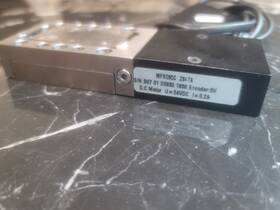
( Brand: Newport ), ( Manufacturer Part Number: MFNO8CC ), ( Model: Z847A ), ( Type: Linear Positioner/stage ), ( Unit Type: Unit ), ( Country Of Origin: France )
Review NEWPORT Lightly Used Fully Tested Linear Motorized Stage Encoder
The **Newport MFNO8CC Linear Motorized Encoder (MFNO8CC-Z847A)** is a high-performance, precision-driven actuator designed for demanding applications in optics, semiconductor manufacturing, and advanced automation systems. This compact yet robust linear motor combines the efficiency of a brushless DC motor with the reliability of a closed-loop encoder system, delivering smooth, repeatable motion with exceptional positional accuracy. Engineered for integration into Newport s modular optical and motion control platforms, this encoder-equipped linear stage offers seamless compatibility with Newport s existing components, including mounts, bases, and control interfaces, ensuring a streamlined and cohesive system design. The motorized encoder mechanism integrates a high-resolution optical encoder directly into the linear actuator, providing real-time feedback on position, velocity, and acceleration with sub-micron precision, making it ideal for applications requiring tight tolerances and high repeatability, such as wafer alignment in lithography systems or precise sample positioning in microscopy. Its lightweight yet durable construction, featuring corrosion-resistant materials and a sealed housing, ensures long-term reliability in both cleanroom and industrial environments. The MFNO8CC-Z847A operates with a compact footprint, measuring just 8 millimeters in width, while maintaining a stroke length of up to 84.7 millimeters, making it perfect for space-constrained applications where efficiency and performance are paramount. Powered by Newport s advanced motion control software, this stage can be easily interfaced with industry-standard protocols like RS-232, USB, or Ethernet, enabling seamless integration into larger automation workflows. Whether used for fine adjustments in optical experiments, precise material handling in manufacturing, or high-speed scanning in imaging systems, the MFNO8CC-Z847A delivers the precision, speed, and reliability required to meet the most exacting technical demands.
The Newport MFNO8CC Linear Motorized Encoder (part number MFNO8CC-Z847A) is a high-precision, motorized linear stage designed for applications requiring precise motion control, such as microscopy, semiconductor inspection, or optical alignment. Below is a detailed breakdown of its pros and cons, followed by a conclusion and recommendation.
---
### **Pros**
1. **High Precision and Resolution**
The stage incorporates a linear motor with an encoder, providing sub-micron positioning accuracy and repeatability. This makes it ideal for applications where fine control is critical, such as in scientific research or industrial metrology.
2. **Fast Acceleration and Velocity**
Linear motor stages generally offer rapid acceleration and deceleration compared to traditional ball-screw or lead-screw stages. This reduces cycle time in automated systems, improving efficiency.
3. **Low Friction and Backlash-Free Motion**
Since linear motors use magnetic levitation (no physical contact between the mover and guide), there is minimal friction and no backlash. This ensures smoother, more reliable motion, especially at high speeds or in dynamic applications.
4. **Compact Design**
The MFNO8CC is relatively compact for its capabilities, making it suitable for installations where space is limited. Its modular design also allows for easy integration into existing systems.
5. **High Load Capacity**
The stage is designed to handle moderate to high loads (typically up to several kilograms, depending on configuration), which is useful for applications involving heavy optics or probes.
6. **Closed-Loop Control**
The integrated encoder provides real-time position feedback, enabling closed-loop control for precise positioning and trajectory following. This is essential for applications requiring high accuracy and stability.
7. **Compatibility with Control Systems**
Newport s stages are often compatible with their own motion controllers (e.g., XPS, ESP) as well as third-party systems like LabVIEW, MATLAB, or custom PLC setups. This flexibility makes it adaptable to various automation needs.
8. **Durability and Reliability**
Linear motor stages are known for their longevity, as they lack wear-prone components like belts or gears. Proper maintenance (e.g., keeping the guide clean and lubricated) can extend the stage s operational life.
9. **Minimal Maintenance**
Unlike stages with mechanical transmissions (e.g., ball screws), linear motor stages require less frequent maintenance. There are no belts to replace or gears to adjust, reducing downtime.
10. **Smooth Motion at Low Speeds**
The absence of mechanical backlash ensures smooth motion even at very low speeds, which is beneficial for delicate operations like focusing or alignment in microscopy.
---
### **Cons**
1. **Higher Initial Cost**
Linear motor stages are generally more expensive upfront than traditional stages (e.g., ball-screw or lead-screw stages). The cost reflects the advanced technology, precision components, and closed-loop control capabilities.
2. **Power Requirements**
Linear motors consume more power than traditional stages, especially during rapid acceleration or high-speed operation. This may require additional electrical infrastructure or cooling solutions in some setups.
3. **Limited Travel Range**
The MFNO8CC has a relatively short travel range (typically 80 mm, as suggested by the "8" in MFNO8CC). For applications requiring longer travel, multiple stages or a different model with extended travel would be needed, increasing complexity and cost.
4. **Sensitivity to Environmental Factors**
Linear motor stages can be sensitive to vibrations, temperature fluctuations, or magnetic interference. Proper mounting (e.g., on an optical table or vibration-isolated platform) and environmental control may be necessary to maintain performance.
5. **Complexity in Setup and Calibration**
Achieving optimal performance often requires careful calibration of the encoder, controller, and motion software. Users without experience in precision motion control may face a learning curve during setup.
6. **Limited Customization for Heavy Loads**
While the stage can handle moderate loads, extremely heavy or bulky payloads may require additional support structures or a different model with a higher load capacity. This could involve custom engineering, adding to costs.
7. **Potential for Magnetic Interference**
Linear motors rely on magnetic fields, which could interact with nearby magnetic materials or sensitive equipment (e.g., MRI systems or certain sensors). Shielding or careful placement may be necessary in some applications.
8. **Dependence on Power Supply Stability**
Fluctuations in power supply voltage or frequency can affect the performance of linear motors, particularly in high-precision applications. A stable power source is recommended.
9. **Warranty and Support Considerations**
While Newport is a reputable manufacturer, warranty coverage and local technical support may vary by region. Users in areas with limited service providers might face challenges in repairs or troubleshooting.
10. **Not Ideal for High-Vibration Environments**
Although linear motors are robust, they may still be affected by excessive external vibrations. Applications in harsh or unshielded environments may require additional damping or isolation.
---
### **Conclusion**
The Newport MFNO8CC Linear Motorized Encoder is an excellent choice for applications demanding high precision, smooth motion, and minimal backlash. Its strengths lie in its sub-micron accuracy, rapid acceleration, and low-maintenance operation, making it ideal for scientific research, semiconductor inspection, or optical alignment tasks. However, its higher cost, power requirements, and limited travel range may not justify its use in applications where simpler or lower-cost stages would suffice. Additionally, users must account for environmental factors and the need for proper calibration to fully leverage its capabilities.
For users prioritizing precision, speed, and reliability in a compact form factor, the MFNO8CC is a strong recommendation. Conversely, those working with longer travel ranges, heavy loads, or budget constraints may need to consider alternatives such as ball-screw stages, lead-screw stages, or other linear motor models with extended travel.
### **Recommendation**
- **Buy the MFNO8CC if:**- Your application requires sub-micron precision and smooth, backlash-free motion.
- You are working in a controlled environment with stable power and minimal vibrations.
- Your budget allows for the higher initial cost, and the stage s benefits outweigh the expenses.
- You need rapid acceleration and deceleration for automated or high-throughput processes.
- The travel range of 80 mm is sufficient for your needs.
- **Consider alternatives if:**- You need longer travel ranges (e.g., >100 mm) and are open to multi-stage solutions or different models.
- Your application involves extremely heavy loads or requires custom engineering for payload support.
- Cost is a critical factor, and a simpler stage (e.g., ball-screw) would meet your precision requirements.
- Your environment has significant vibrations or magnetic interference that could affect performance.
For most precision motion control applications where cost is not the primary constraint, the MFNO8CC is a robust and reliable investment. Pair it with appropriate mounting, control software, and environmental safeguards to ensure optimal performance.
Details:
Shipping: USPS Ground, 2 day turnaround once item has been paid for. Hello,What your viewing is a Lightly Used Fully Tested Newport Motorized Linear Stage Encoder model number MFNO8CC - Z847A.
part #: mfno8cc prices
- $900.00-$2500.00
specifications linactuat:
- brand: Newport
- mpn: Mfno8cc
- model: Z847a
- type: Linear Positioner/stage
- unit type: Unit
- country of origin: France
offer linactuat:
- sold: 0
- quantity: 2
- availability: In Stock
- started: June 4, 2026
- options: Ship-to-home
returns linactuat:
- policy: No Returns
seller linactuat:
- # reviews: 34
- city: Miami, Florida
- rating: 97.2%
shipping linactuat:
- type: Calculated
- carrier: USPS
- transit: 6-13 Days
- class: Standard
- cost: $9.54
- service: USPS Ground Advantage
payments linactuat:
- credit card: Diners-club
- wallet: Google-pay
- other
general linactuat:
- condition: Used
- Industrial Automation Motion Controls > Rotary Linear Motion > XY Rotary Positioning Stages
Newport MFNO8CC Is Similar To:
- 422-1s Newport Linear Stage Tbd (37.6% similar) Shipping: I only ship inside the USA. Condition: used, item was pulled from a working environment. It does show small damage like scratches scuffs dents...(December 17th, 2017)
- 460a Xyz Newport Nrc Axis Stage Positioner New (34.8% similar) It is new in the original packaging. This is a Newport model 460A XS three axis positioner...(March 1st, 2018)
- 481-a Newport Rotation Stage Brand New In Original Box (28.6% similar) 2MM load CAPACITY178 n SENSITIVITY30 arc SECGRADUATIONS1 VERNIER5 min thread TYPE8-32 and 1/4 20OPTIC DIAMETER25. The outer stage is a high resolution, tangentially driven design. 9 NM WEIGHT0. Scale markings indicating every degree and a vernier with 5 arc min are engraved on the side of stage. 1MM...(September 22nd, 2018)
- 562-xyz Newport Ultralign Stage Micrometers (34.1% similar) Newport ultralight 562-XYZ 3-AXIS stage, left-handed, SM13 micrometers. Stage is in excellent working condition...(November 9th, 2018)
- 850-a Newport Motorized Precision Actuator (34.4% similar) Location: FDR Newport 850-A motorized precision actuator with case physical condition: used, but in good condition, item does power up no other testing has been done...(August 15th, 2017)
- 850a-05 Newport Motorized Precision Linear Motion Actuator (38.9% similar) It comes with a 14 day guarantee against being DOA from receipt. Always here to help. Newport 850A-05 motorized precision linear motion actuator 850AQUESTIONS. Here : this lot is for one. Orders are shipped to the cardholders billing address. Warranty this item is guaranteed to be as described. ...(September 28th, 2018)
- 850b-1-hs Newport 1-inch Travel Linear (32.3% similar) Save packaging for carrier claim. Please by sending a message through or calling. DOA stands for dead on arrival, meaning that the item did not function properly when it arrived. All parts, accessories, cables, etc. Our contact: Rodney Wang SC asset management, inc. All pictures are taken in house. ...(July 10th, 2017)
- 9401 Newport Great Rotary Mount Stage Optical Waveplate Polarizer Thread (35.4% similar) Resolution with a built-in vernier scale. Lightly used Newport 9401 rotary mount stage for 1 wave plates or polarizes with 8-32 mounting thread condition: this item is but in excellent condition. Lockable with setscrews. To prevent accidental misalignment, simply remove the lever from stage. Stored ...(January 11th, 2019)
- Bgm50cc Newport Motorized Goniometer Cradle (35.7% similar) This fee will vary depending on the size of item. Please for more details. Guaranteed fully functional. All we ask is you before opening a return request so have an opportunity to fix the issue getting involved. The calculator is simply one estimate and can be off at times. Ste a sparks, NV please ...(February 23rd, 2018)
- Cma-25cc Newport Motorized Linear Actuator Range (35.8% similar) This actuator can be used with Newport 861 controller not included or equivalent. Tested, fully functional, and in excellent condition. Used Newport CMA-25CC motorized linear actuator, 25MM travel range with an audio jack connector and cable...(September 22nd, 2018)
- Cma-25pp Newport Cma Motorized Linear (37.4% similar) Please for next day shipping options. Very lightly used, in perfect working order, guaranteed. The use of this packaging is included in most higher end and heavier fragile items. Please for pricing. Ste a sparks, NV please with any questions. Depending on the size of item there may be a pelleting ...(February 22nd, 2018)