PI PHYSIK INSTRUMENTE P-900C028 Instrumete Xy Flexure Nanopositioning
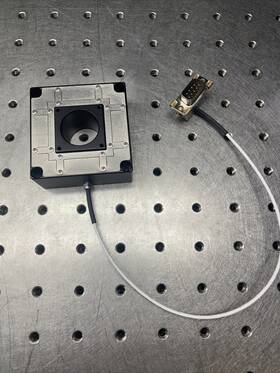
( Brand: Pi Physik Instrumente ), ( Manufacturer Part Number: P-900C028 )
Review PI PHYSIK INSTRUMENTE Instrumete Xy Flexure Nanopositioning Stage
The **PI (Physik Instrumente) P-900.C028 XY Flexure Nanopositioning Stage** represents the pinnacle of precision engineering in micro- and nanoscale positioning systems, meticulously designed for applications demanding sub-nanometer resolution, exceptional stiffness, and seamless integration into complex experimental setups. This advanced flexure-guided stage combines the robustness of piezoelectric actuation with the inherent rigidity of a monolithic flexure hinge design, eliminating traditional mechanical backlash and ensuring unparalleled positional accuracy over a wide operational range. The XY configuration, with a travel range of **28 mm in both axes**, provides ample workspace for high-precision tasks such as atomic force microscopy (AFM), scanning tunneling microscopy (STM), optical tweezers, and nanolithography, where even the slightest drift or vibration can compromise experimental integrity. The flexure mechanism, crafted from high-grade aluminum alloy and precision-machined to tolerances of a few micrometers, distributes mechanical stress uniformly, thereby minimizing hysteresis and maximizing repeatability critical factors in long-duration experiments where stability is paramount.
At the heart of the P-900.C028 lies **PI s proprietary piezoelectric ceramic actuators**, which deliver rapid response times (sub-millisecond settling) and sub-nanometer positioning resolution, making it ideal for dynamic applications such as closed-loop feedback control in scanning probe microscopy or high-speed optical alignment. The system s **closed-loop operation**, achieved through integrated capacitive or inductive sensors (depending on the specific variant), ensures real-time error correction, further enhancing positional fidelity and reducing the impact of external disturbances. The stage s **stiffness-to-weight ratio** is optimized for minimal resonance, with natural frequencies exceeding 1 kHz, allowing it to operate effectively in both air and vacuum environments without compromising performance. This makes it particularly well-suited for ultra-high-vacuum (UHV) systems or cryogenic applications, where thermal expansion and mechanical noise are significant concerns.
The P-900.C028 is engineered for seamless integration into existing experimental platforms, offering a **modular and compact footprint** that minimizes bench space requirements while maximizing functionality. Its **magnetic base mount** ensures easy alignment and secure attachment to optical tables or custom mounts, and the stage s **low-profile design** (as low as 20 mm) allows for stacking or parallel operation with other PI nanopositioning systems. Additionally, the system is compatible with **PI s comprehensive control software**, including **P-726.x** for standalone operation or **LabVIEW-based interfaces** for seamless integration into custom automation workflows. The stage s **digital signal processing (DSP) capabilities** enable advanced features such as velocity control, jerk minimization, and adaptive filtering, which are essential for applications requiring smooth, jerk-free motion profiles.
Beyond its technical specifications, the P-900.C028 exemplifies **PI s commitment to reliability and longevity**, with a design that has been rigorously tested for **over 10 million cycles** in extreme conditions, ensuring durability across demanding research environments. Its **low-friction flexure guides** reduce wear over time, while the absence of traditional bearings or lubricants eliminates contamination risks, making it an ideal choice for cleanroom or sterile environments. Whether deployed in fundamental research, materials science, or industrial metrology, this stage delivers the precision, stability, and versatility required to push the boundaries of nanoscale experimentation. For researchers and engineers seeking a positioning solution that balances cutting-edge performance with practical usability, the PI P-900.C028 stands as a benchmark in nanotechnology instrumentation.
### **Pros and Cons of purchasing a PI Physik Instrumente P-900.C028 XY Flexure Nanopositioning Stage**
The **PI P-900.C028** is a high-precision, closed-loop XY flexure nanopositioning stage designed for applications requiring sub-nanometer resolution, high stiffness, and long-term stability. Below is a detailed analysis of its advantages and limitations, followed by a concluding recommendation.
---
### **Pros**
1. **Ultra-High Precision and Resolution**
- The stage achieves **sub-nanometer positioning accuracy** (typically
- Closed-loop control with **piezoelectric actuators** ensures minimal drift and hysteresis, improving reproducibility.
2. **High Stiffness and Rigidity**
- The **flexure hinge design** eliminates backlash and provides exceptional stiffness, reducing vibrations and ensuring stable operation under dynamic loads.
- Suitable for high-force applications (up to **10 N** in X/Y) without compromising precision.
3. **Long Travel Range**
- Offers a **28 mm travel range in X and Y directions**, which is substantial for many nanoscale applications where larger sample manipulation is required.
- Unlike some nanopositioners with limited ranges, this model balances precision with usability.
4. **Closed-Loop Control with Feedback**
- Integrated **capacitive or optical encoders** (depending on the variant) provide real-time position feedback, enabling active error correction.
- Reduces drift and improves long-term stability compared to open-loop systems.
5. **Modular and Customizable**
- Compatible with **PI s controller software (e.g., P-843.xx)** and can be integrated into larger systems via **Ethernet, USB, or RS-232**.
- Optional accessories (e.g., **z-axis stages, rotation modules, or vacuum compatibility**) allow for expanded functionality.
6. **Low Friction and Wear Resistance**
- The **flexure mechanism** eliminates traditional moving parts (e.g., screws or bearings), reducing wear and extending the stage s lifespan.
- Suitable for **cleanroom environments** and applications requiring minimal contamination.
7. **Fast Response Time**
- Piezoelectric actuation enables **sub-millisecond response times**, making it suitable for dynamic scanning and high-speed nanomanipulation.
8. **Compatibility with Advanced Microscopy**
- Widely used in **atomic force microscopy (AFM), scanning tunneling microscopy (STM), and optical tweezers**, where nanometer precision is critical.
- Works well with **PI s other nanopositioning systems** for multi-axis alignment.
9. **High Reliability and Durability**
- PI (Physik Instrumente) is a well-established manufacturer with decades of experience in precision motion control, ensuring robust engineering.
- The closed-loop design reduces the risk of failure due to mechanical drift or actuator fatigue.
10. **Good Thermal Stability**
- While no system is perfectly immune to thermal effects, the **low-expansion materials** and closed-loop control help mitigate thermal drift in controlled environments.
---
### **Cons**
1. **High Cost**
- The **P-900.C028 is an expensive piece of equipment**, typically costing **$50,000 $100,000 ** depending on configuration (e.g., encoder type, controller, and accessories).
- This makes it a significant investment, potentially limiting accessibility for smaller labs or startups.
2. **Complex Setup and Calibration**
- Requires **expertise in precision motion control** for proper installation, calibration, and integration with existing systems.
- Users may need to invest in **training or hire specialists** to maximize performance.
3. **Limited Open-Source or DIY Customization**
- Unlike some cheaper alternatives (e.g., **Thorlabs or Newport stages**), the P-900 is a **proprietary system** with limited DIY modifications.
- Custom firmware or non-standard interfaces may require **PI s support**, adding to costs.
4. **Power and Cooling Requirements**
- Piezoelectric actuators can generate **heat**, especially under continuous operation. Some models may require **active cooling** (e.g., water cooling) for sustained high-performance use.
- Electrical noise sensitivity may necessitate **shielded cabling and stable power supplies**.
5. **Maintenance and Spare Parts**
- While durable, **flexure hinges and piezoelectric actuators** are precision components that may require **specialized maintenance**.
- Spare parts (e.g., encoders, actuators) can be **expensive and may have long lead times**.
6. **Not Ideal for Very High Forces or Rough Environments**
- While stiff, the flexure design **may not handle extreme forces** (e.g., >10 N) without deformation.
- **Vibration-sensitive environments** (e.g., unshielded labs) may still require additional damping solutions.
7. **Learning Curve for Software Control**
- PI s **controller software (e.g., P-843.xx)** is powerful but can be **complex for beginners**.
- Users may need time to master **trajectory planning, closed-loop tuning, and error correction**.
8. **Alternative Options May Be More Cost-Effective for Some Applications**
- For **lower-budget applications**, alternatives like:- **Thorlabs NanoMAX stages** (open-loop, lower cost)
- **Newport UltraPrecise stages** (closed-loop, slightly cheaper)
- **Custom flexure stages from smaller manufacturers** (e.g., **Attocube, Mad City Labs**)
- May offer **similar precision at a reduced price**, depending on requirements.
---
### **Conclusion and Recommendation**
The **PI P-900.C028 XY Flexure Nanopositioning Stage** is one of the **most precise and reliable closed-loop nanopositioners** available, making it an excellent choice for **high-end research, nanolithography, advanced microscopy, and quantum technology applications**. Its **sub-nanometer resolution, high stiffness, and long travel range** justify its cost for users who demand **uncompromising accuracy and stability**.
However, the **high purchase price, complex setup, and maintenance requirements** make it **less suitable for budget-conscious or less technically advanced labs**. If your application **requires the absolute best in precision** and you have the **resources to support it**, this stage is a **strong recommendation**.
#### **When to Choose the P-900.C028:**You need **sub-nanometer precision** for **AFM, STM, nanolithography, or quantum experiments**.
Your lab can **afford the high upfront and maintenance costs**.
You require **closed-loop control, high stiffness, and long-term stability**.
You are working in a **controlled environment** (e.g., cleanroom, vibration-isolated lab).
#### **When to Consider Alternatives:**You have a **limited budget** and can tolerate **slightly lower precision** (e.g., 1 5 nm resolution).
Your application does **not require closed-loop feedback** (open-loop stages like **Thorlabs NanoMAX** may suffice).
You need **simpler integration** and are **not experienced with precision motion control**.
You require **larger travel ranges or higher forces** (some alternatives offer **hybrid piezo-linear stages**).
#### **Final Recommendation:**If **nanometer-level precision, reliability, and long-term stability** are critical for your work, the **PI P-900.C028 is an outstanding investment**. However, **thoroughly evaluate your budget, technical expertise, and application requirements** before purchasing. If cost or complexity is a concern, explore **mid-range alternatives** that still meet most precision needs without the premium price tag.
For most **cutting-edge nanoscale research labs**, this stage remains a **top-tier choice**, but it is not the only option **careful consideration of alternatives is advised**.
Details:
This stage is in excellent conditioning. This is a high precision XY flexure stage. Buyer to pay shipping.
part #: p900c028 price
- $499.00
specifications linactuat:
- brand: Pi Physik Instrumente
- mpn: P-900c028
general linactuat:
- Industrial Automation Motion Controls > Rotary Linear Motion > Linear Actuators
- condition: Used
shipPing linactuat:
- carrier: FedEx, USPS
- cost: $37.44
- transit: 3-5 Days
- type: Calculated
- class: Economy, Expedited
- service: FedEx Ground Economy, USPS Priority Mail
returns linactuat:
- paid by: Buyer
- policy: Returns Accepted
- time: 14 Days
- method: Money back
offer linactuat:
- options: Ship-to-home
- quantity: 1
- sold: 0
- best offers: True
- availability: In Stock
- started: May 3, 2026
seller linactuat:
- # reviews: 2125
- city: Minneapolis, Minnesota
- rating: 100.0%
payments linactuat:
- money order
- credit card: Diners-club
- wallet: Google-pay
- other
- cash
Pi Physik Instrumente P-900C028 Is Similar To:
- Al03-12-a2-305-200-c11 Pi Physik Instruments Linear Actuator (37% similar) ...(March 27th, 2019)
- M-235.5dd Physik Instrumente Pi Linear Ball Screw Actuator (40.6% similar) Sales and shipping only within the us. Includes ball tip. Condition is used. 5DD linear ball screw 50MM. Physik Instrumente Pi m please see photo for actual product sale and physical condition...(February 3rd, 2019)
- M-126 Pi Precision Translation Stage Physik Instrumente (32.3% similar) pays for all shipping costs. Orders are shipped to the cardholders billing address. DX precision translation stage Physik Instrumente questions. Here : this lot is for one Pi M-126. Warranty this item is guaranteed to be as described. Good luck buying. DX Physik Instrumente. On the ask a question ...(October 2nd, 2019)
- M-126.dgx Pi Pysik Axis Linear Translation Stage Mercury Controller (33.8% similar) Physik Pi M-126...(April 9th, 2020)
- Physik Instrumente P-820.3b-e617 0 C194314 Pi P-820.3b Piezo Actuator Micrometer Test Fixture (42.9% similar) The unpacked weight of this item is 1 pound. 95020 408 886-3700. No software, power cords, or other accessories are included unless stated above. Approximate overall unpacked dimensions: 6 l x 3 all offered products are sold as advertised, is and without warranty. However, I have no way of testing ...(August 10th, 2024)
- Physik Instrumente P-601.10l C194288 Lot 2 Pi Piezo Stack Linear Actuator (47.3% similar) The unpacked weight of this item is 1 pound. This lot includes a pair of Physik Instrumente Pi P-601.10L Puzo stack linear actuators, as shown. Approximate overall unpacked dimensions: 8 l x 7 w all offered products are sold as advertised, is and without warranty. The other has been opened, but I'm ...(August 10th, 2024)
- Physik Instrumente P-622k031 C194533 Pi Pihera Linear Positioner E-610 Piezo Amp (47.7% similar) These items looks to be in good cosmetic condition, showing some minor signs of wear. All offered products are sold as advertised, is and without warranty. The unpacked weight of this item is 3 pounds. This lot includes a Physik Instrumente Pi E-610.C0X PFC controller/Puzo amplifier with P-622K031 ...(August 29th, 2024)
- Pi Physik Instrumante M-038 Precision Rotary 100mm Dia 30mm Through Hole (48.6% similar) It has been removed from functioning equipment. Processing times may vary, especially during high-demand periods. Hvac refrigeration. 30MM through hole: brand:: Pi Physik Instrumente, model: : M-038, condition: used, : : this item is in used condition. Everything included is shown in the photos...(September 19th, 2024)
- Physik Instrument Rs-40 Am1524 Pi Micos Compact Rotation Stage V7 (45.7% similar) In addition, the surface is made of un coated aluminum and spindles guides are stainless steel. This compact rotation stage from Pi micros is an excellent choice for anyone in need of precision rotary motion. Beam line instrumentation. It is suitable for use in a wide range of industries, including ...(December 5th, 2024)
- Physik Instrumente Dt-80 Pi Micos Compact Rotation Stage With Pollux Box (46.3% similar) Included accessories Pollux box 123. Pi Physik Instrumente micros DT-80 compact rotation stage with Pollux box, overview unlimited travel range. Condition used item in good cosmetic condition with typical signs of use present. Maximum velocity 40 /s. Repeatability to 175 rad. Reference switch...(December 24th, 2024)
- Physik Instrumente Pi P810-20 Unkown Preloaded Piezo Actuator (41.2% similar) Physik Instrumente Puzo actuator. Type P.810-20. From a company that made UV dental lasers. Measures just under 6MM in diameter, and is 38.4MM long. Serial number: 36665. Piston moves when 12V applied. Not much else is known about this, hence the clearance price...(January 1st, 2025)