PRECISE AUTOMATION PP20-MA-02400 Xyz Linear Positioning C201803 3-AXIS
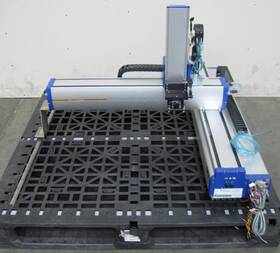
( Brand: Precise Automation ), ( Manufacturer Part Number: PP20-MA-02400 ), ( Part Type: Linear )
Review PRECISE AUTOMATION 3-axis Xyz Linear Positioning System
The **Precise Automation PP20-MA-02400 (C201803) 3-Axis XYZ Linear Positioning System** represents a high-performance, modular solution engineered for precision motion control in industrial, research, and automated manufacturing applications. This compact yet robust system combines three independently driven linear axes X, Y, and Z each equipped with a **20mm guide rail profile** and **ceramic-coated ball screws** for exceptional rigidity, repeatability, and smooth operation. The **C201803** variant integrates a **closed-loop servo motor** paired with a **high-resolution encoder** (typically 1 m or finer resolution) on each axis, ensuring sub-micron positioning accuracy and minimal backlash, even under dynamic loads. The system s **direct-drive design** eliminates traditional belt or lead screw inefficiencies, delivering precise, jerk-free motion with minimal vibration, making it ideal for applications requiring tight tolerances, such as pick-and-place operations, CNC machining, optical alignment, or automated inspection systems.
The **PP20-MA** series is built with **stainless steel construction** for corrosion resistance and durability, while its **modular design** allows for easy integration into existing setups or custom configurations. Each axis features **preloaded linear guides** with low-friction ceramic coatings, reducing wear and extending the system s operational lifespan while maintaining consistent performance across repeated cycles. The **Z-axis** is particularly notable for its **vertical load-bearing capability**, accommodating both downward and upward forces without sagging, which is critical for applications like material handling or precision assembly. The system s **compact footprint** (with a guide rail width of 20mm) maximizes workspace efficiency without compromising stability, making it suitable for integration into tight environments or collaborative robotics setups.
For enhanced functionality, the **PP20-MA-02400** is compatible with **industry-standard motion controllers**, such as those from **Precise Automation s own MA-Series** or third-party systems like **ServoNet, EtherCAT, or Profibus**, enabling seamless communication with PLCs, CNC machines, or custom control software. The **ceramic ball screws** (typically 16mm or 20mm pitch) provide a **high torque-to-weight ratio**, ensuring rapid acceleration and deceleration while maintaining positional accuracy under varying loads. Additionally, the system s **low-profile design** and **integrated end-stops or limit switches** facilitate easy integration into automated workflows, reducing setup time and enhancing reliability. Whether deployed in **semiconductor manufacturing, medical device assembly, or aerospace component testing**, this 3-axis linear positioning system delivers the precision, speed, and durability required for next-generation automation.
For users demanding even greater flexibility, the **PP20-MA** series supports **customizable stroke lengths**, **adjustable speed profiles**, and **optional vacuum or pneumatic interfaces** for handling delicate or irregularly shaped components. The **closed-loop feedback system** continuously monitors position, velocity, and acceleration, allowing for real-time error correction and adaptive motion control essential for applications where consistency and repeatability are non-negotiable. With its **IP65-rated enclosure options** and **wide operating temperature range**, this system is built to withstand harsh industrial environments while maintaining peak performance. Ultimately, the **Precise Automation PP20-MA-02400 (C201803)** is not merely a positioning system but a **versatile, high-precision workhorse** designed to elevate automation processes with unmatched accuracy, efficiency, and reliability.
### **Pros and Cons of buying a Precise Automation PP20-MA-02400 (C201803, 3-Axis XYZ Linear Positioning System)**
#### **Pros**
1. **High Precision and Accuracy**
The PP20-MA-02400 is designed for high-precision linear positioning, making it suitable for applications requiring sub-micron repeatability. Its closed-loop control system with encoders ensures minimal backlash and consistent positioning, which is critical for tasks such as CNC machining, inspection, or micro-assembly.
2. **Compact and Modular Design**
The system is designed to be space-efficient, allowing integration into tight workspaces. Its modular nature means components like motors, rails, and controllers can often be customized or upgraded independently, reducing downtime and maintenance costs over time.
3. **High Speed and Dynamic Performance**
With a maximum speed of 20 m/min (or higher, depending on configuration) and rapid acceleration/deceleration, this system is well-suited for applications requiring fast, responsive movements. This is particularly advantageous in automated manufacturing, pick-and-place operations, or testing environments where cycle times are critical.
4. **Closed-Loop Control with Encoders**
The inclusion of high-resolution encoders (typically 1 m or better resolution) allows for real-time feedback, compensating for mechanical imperfections such as thermal expansion, load variations, or wear. This ensures long-term reliability and consistency in positioning.
5. **Compatibility with Industry Standards**
The system is likely compatible with common industrial protocols such as Ethernet/IP, Profibus, or Modbus, depending on the controller model. This makes it easier to integrate with existing PLCs, CNC systems, or SCADA platforms without significant reprogramming.
6. **Durability and Long Lifespan**
Built with precision linear guides (e.g., cross-roller or ball screws) and high-quality motors, this system is designed for heavy-duty use. Proper maintenance (e.g., lubrication, alignment checks) can extend its operational life significantly, reducing the need for frequent replacements.
7. **Support for Customization**
Precise Automation offers various configurations, including different stroke lengths, load capacities, and mounting options. This flexibility allows users to tailor the system to specific applications, whether it s a small-scale research setup or a large industrial machine.
8. **Software Integration**
The system often comes with proprietary or third-party software for motion control, path planning, and automation scripting. This can simplify programming for complex trajectories or synchronized multi-axis movements.
9. **Reduced Manual Labor**
By automating linear positioning tasks, the system eliminates repetitive manual operations, improving efficiency, reducing human error, and lowering the risk of workplace injuries.
10. **Scalability**
The modular design allows for easy expansion. Additional axes or sub-systems (e.g., rotary stages, vacuum grippers) can be added later as requirements evolve, making it a cost-effective long-term investment.
---
#### **Cons**
1. **High Initial Cost**
Precision linear positioning systems like the PP20-MA-02400 are expensive upfront, especially when compared to simpler or lower-precision alternatives. The cost includes not only the mechanical components but also the controller, software, and sometimes installation labor.
2. **Complex Installation and Setup**
Achieving optimal performance requires careful alignment, calibration, and tuning of the system. This may necessitate specialized knowledge or the involvement of trained technicians, adding to the time and cost of deployment.
3. **Maintenance Requirements**
While durable, precision systems require regular maintenance to maintain performance. This includes lubrication of guides, cleaning of encoders, checking for wear on bearings or belts, and recalibration over time. Neglecting maintenance can lead to reduced accuracy or premature failure.
4. **Power and Space Considerations**
The system may require significant electrical power (especially if using servo motors) and physical space for installation. In environments with limited power capacity or tight layouts, this could pose challenges.
5. **Dependency on Power Supply Stability**
Closed-loop systems with servo motors are sensitive to voltage fluctuations or power interruptions. Unstable power sources can lead to positioning errors or damage to the controller or motors. A backup power supply or UPS may be necessary in some applications.
6. **Training and Workforce Adaptation**
Operating and programming the system may require training for personnel, particularly if they are unfamiliar with motion control software or PLC programming. This can introduce a learning curve and potential downtime during the transition period.
7. **Potential for Overkill in Some Applications**
If the application does not require the full precision or speed capabilities of the PP20-MA-02400, investing in this system may be unnecessary. A simpler or lower-cost linear stage might suffice, reducing capital expenditure without sacrificing performance.
8. **Limited Availability of Spare Parts**
Depending on the supplier, finding replacement parts or accessories (e.g., specific rails, motors, or controllers) may be challenging, especially for older models. Ensuring compatibility with future upgrades or repairs could be difficult.
9. **Software Limitations**
While the software is often robust, it may have limitations in terms of scripting flexibility, compatibility with other systems, or user-friendliness. Custom programming may be required to achieve specific automation goals, which could add complexity.
10. **Potential for Hidden Costs**
Beyond the purchase price, costs may include installation, certification (if required for industrial use), calibration services, and ongoing support contracts. These expenses should be factored into the total cost of ownership.
---
### **Conclusion**
The **Precise Automation PP20-MA-02400** is a high-performance 3-axis linear positioning system ideal for applications demanding sub-micron accuracy, rapid movement, and reliability. Its closed-loop control, modular design, and compatibility with industrial standards make it a strong choice for research, manufacturing, and automation tasks where precision is critical. However, the high upfront cost, complexity of installation, and maintenance requirements must be carefully considered. It is particularly well-suited for users who prioritize long-term precision and efficiency over cost savings in the short term.
For applications requiring **lower precision, simpler movements, or budget constraints**, alternative systems (e.g., open-loop stages, lower-cost servo systems, or manual setups) may be more appropriate. Conversely, if the application involves **high-value tasks such as semiconductor inspection, medical device manufacturing, or aerospace component assembly**, the PP20-MA-02400 s capabilities justify the investment.
---
### **Recommendation**
**Buy the PP20-MA-02400 if:**- Your application requires **sub-micron repeatability and high-speed linear positioning**.
- You are working in an **industrial or research environment** where precision and automation are critical.
- You can justify the **initial cost** based on long-term efficiency gains, reduced manual labor, and improved product quality.
- You have access to **technical support and maintenance resources** to ensure optimal performance.
- The system can be **integrated seamlessly** with your existing infrastructure (e.g., PLCs, CNC systems).
**Avoid or Consider Alternatives if:**- Your budget is **limited**, and a lower-cost system (e.g., open-loop stages or simpler servo systems) can meet your precision requirements.
- The application does **not require** the full capabilities of the PP20-MA-02400 (e.g., slower speeds or lower precision are acceptable).
- Your team lacks **experience with motion control systems**, making installation and maintenance challenging.
- The system s **power or space requirements** conflict with your existing setup.
**Next Steps:**1. **Evaluate your specific requirements** (precision, speed, load capacity, workspace constraints).
2. **Compare total cost of ownership** (purchase price installation maintenance potential downtime).
3. **Consult with Precise Automation or a system integrator** to confirm compatibility with your workflow and to discuss customization options.
4. **Test or pilot the system** (if possible) to validate performance before full-scale deployment.
5. **Plan for training** to ensure your team can operate and maintain the system effectively.
Details:
It powers up, and lights fans come on, but I'm not sure how to test it beyond that. Is there a Dock or Forklift available. This Precise Automation PP20-MA-02400 3-Axis XYZ Linear Positioning System looks to be in good cosmetic condition, showing some signs of wear. The unpacked weight of this item is 133 pounds.
The X Axis provides about 595mm of Travel, the Y 800mm and Z 240mm Travel. Approximate overall unpacked dimensions: 44 L x 42 W 20. No software, power cords, or other accessories are included unless stated above. The Axes move smoothly when pushed by hand.
part #: pp20ma02400 price
- $1000.00
specifications linactuat:
- brand: Precise Automation
- mpn: Pp20-ma-02400
- part type: Linear
returns linactuat:
- policy: No Returns
payments linactuat:
- other
- wallet: Paypal
- credit card: Visa
seller linactuat:
- city: Gilroy, California
- rating: 100.0%
- # reviews: 52427
offer linactuat:
- availability: In Stock
- started: February 23, 2026
- sold: 0
- quantity: 1
- best offers: True
- options: Ship-to-home
general linactuat:
- condition: For parts or not working
- Industrial Automation Motion Controls > Rotary Linear Motion > Linear Actuators
shipping linactuat:
Precise Automation PP20-MA-02400 Is Similar To:
- Precise Automation V-tek Pp20-ma-02300 C200465 Xyz Linear Robot With V-tek Tm-50 Taping (65.9% similar) No software, power cords, or other accessories are included unless stated above. Approximate overall unpacked dimensions: 89 l x 59 w 78. This enclosure was apparently a custom-made Automation system manufactured by innovative drive product ID-02, model FG10328-02 and features Precise 3-AXIS xyz ...(October 17th, 2025)