MAGNETIC SENSOR SYSTEMS R-09-150-30SCWM Mss Solenoid Rotary 12V
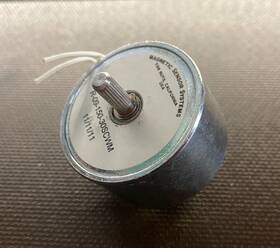
( Brand: Magnetic Sensor Systems ), ( Manufacturer Part Number: R-09-150-30SCWM ), ( Part Type: Solenoid ), ( Country Of Origin: United States )
Review MAGNETIC SENSOR SYSTEMS Mss Solenoid Rotary 12v
The **MSS R-09-150-30SCWM Solenoid Rotary Magnetic Sensor** is a high-performance, precision-engineered component designed for advanced industrial automation, robotics, and motion control applications where reliable angular position detection is critical. This compact yet robust sensor combines a **12V DC solenoid-driven rotary mechanism** with a **Hall-effect-based magnetic detection system**, delivering exceptional accuracy and repeatability in dynamic environments. The sensor s **90-degree (0.5 radian) rotational range** provides a precise, full-cycle feedback signal, making it ideal for applications such as valve actuation, linear-to-rotary conversion, indexing systems, or as a feedback device in closed-loop servo control. Its **magnetic coupling design** ensures zero mechanical wear and tear, eliminating the need for lubrication while maintaining long-term reliability under continuous operation. The **SCWM (Sealed, Corrosion-Resistant, Waterproof, and Moisture-Resistant) construction** incorporates a durable housing with IP67 ingress protection, safeguarding internal components from dust, debris, and liquid ingress making it suitable for harsh industrial settings, outdoor installations, or environments exposed to splashes and condensation. The sensor s **low-power 12V DC solenoid** ensures efficient operation while generating a strong, consistent magnetic field, which interacts seamlessly with the integrated Hall-effect switch to produce a clean, digital output signal. This output can be configured for either **normally open (NO) or normally closed (NC) switching**, or used in differential mode for enhanced noise immunity, depending on the application s requirements. With a **response time of less than 10 milliseconds**, the sensor provides rapid feedback, enabling high-speed control systems to react dynamically to positional changes. Additionally, its **compact footprint** and versatile mounting options including threaded, flanged, or direct-shaft integration allow for seamless integration into existing machinery or custom-built systems without excessive modification. Whether deployed in automated manufacturing, medical equipment, or renewable energy systems, this sensor delivers a dependable, maintenance-free solution for precise angular detection, ensuring optimal performance in demanding operational conditions.
**Pros and Cons of buying a Magnetic Sensor (MSS R-09-150-30SCWM) Solenoid Rotary 12V**
### **Pros**
1. **High Precision and Reliability** This sensor is designed for accurate position detection in rotary applications, making it suitable for industrial automation, robotics, or machinery where precise feedback is critical. Its magnetic sensing technology ensures consistent performance over time, reducing wear and tear compared to mechanical switches.
2. **Compact and Durable Design** The sensor is likely built to withstand harsh environments, including exposure to dust, moisture, and temperature fluctuations, depending on its enclosure rating (if applicable). Its compact form factor allows for easy integration into tight spaces.
3. **Low Power Consumption (12V)** Operating at 12V simplifies power integration with existing systems, reducing the need for additional voltage conversion. This also contributes to energy efficiency in long-running applications.
4. **Non-Contact Operation** Unlike mechanical switches or encoders with moving parts, this magnetic sensor operates without physical contact, minimizing the risk of failure due to friction, debris, or mechanical fatigue. This extends the lifespan of both the sensor and the system it s installed in.
5. **Versatility in Applications** The sensor can be used in various rotary motion detection tasks, such as:- **Position sensing** (e.g., determining if a shaft is in a specific orientation).
- **Speed monitoring** (when paired with timing logic).
- **Fault detection** (e.g., detecting misalignment or abnormal movement).
- **Automation triggers** (e.g., activating relays or controlling actuators).
6. **Easy Installation and Calibration** Magnetic sensors like this typically require minimal setup. The sensor can be mounted near a rotating magnet or marked surface, and its output (usually digital or analog) can be directly interfaced with microcontrollers (e.g., Arduino, PLC) or other control systems without complex wiring.
7. **Cost-Effective for Specific Needs** While not as high-resolution as optical encoders, this sensor offers a balance between simplicity and functionality. For applications where absolute precision isn t critical but reliability and durability are, it can be a cost-effective alternative to more expensive solutions.
8. **Compatibility with Existing Systems** If your system already uses 12V components or magnetic-based sensors, integrating this part will be seamless. It may also work with standard logic gates, microcontrollers, or relay-based control circuits.
---
### **Cons**
1. **Limited Resolution** Unlike incremental or absolute encoders, this sensor typically provides discrete position feedback (e.g., "detected" or "not detected") rather than continuous angular data. This means it cannot measure fine movements or provide exact rotational angles unless paired with additional logic (e.g., counting pulses from multiple sensors).
2. **Dependence on External Magnets** The sensor requires a compatible magnet (often provided or specified separately) to be placed on the rotating object. Misalignment or weak magnets can lead to false readings or inconsistent performance. Users must ensure proper magnet placement and strength.
3. **No Built-In Indexing or Zero Reference** Without additional hardware (e.g., a reference magnet or mechanical stop), the sensor may not provide a clear "home" or zero position. This requires external logic to establish a reference point, adding complexity to the system design.
4. **Signal Noise Sensitivity** Magnetic sensors can be affected by external magnetic fields or interference from nearby electronics. In noisy environments, additional shielding or filtering may be necessary to ensure accurate readings.
5. **Output Limitations** The sensor s output is likely a simple digital signal (e.g., open-collector or PNP/NPN output) rather than an analog voltage or high-resolution digital interface. This limits its use in applications requiring fine-grained data processing without additional circuitry.
6. **Potential Latency in Dynamic Systems** In high-speed applications, the sensor s response time may introduce slight delays in detecting position changes, which could affect real-time control systems.
7. **Vendor-Specific Compatibility** While the part number suggests a standard component, compatibility with specific control systems (e.g., PLCs, microcontrollers) may require additional drivers, libraries, or adapters. Always verify datasheet specifications before purchase.
8. **No Built-In Diagnostics** Unlike some advanced sensors, this part may not include self-diagnostic features (e.g., fault codes or health monitoring). Troubleshooting issues like magnet misalignment or sensor failure may require manual inspection.
---
### **Conclusion**
The **MSS R-09-150-30SCWM** solenoid rotary magnetic sensor is a practical choice for applications requiring **reliable, non-contact position detection in rotary systems** where high precision is not critical. Its strengths lie in **durability, simplicity, and low power operation**, making it ideal for industrial automation, basic robotics, or machinery where mechanical switches would fail over time. However, its **discrete output, dependency on external magnets, and lack of high-resolution feedback** limit its use in applications needing fine angular measurements or continuous speed monitoring.
For users with **simple position sensing needs** (e.g., detecting if a shaft is in a specific orientation, triggering actions at fixed points), this sensor is a **cost-effective and robust solution**. For applications requiring **high-resolution feedback, speed measurement, or absolute positioning**, a **rotary encoder (incremental or absolute)** or a **hall-effect sensor with additional processing** would be more appropriate.
---
### **Recommendation**
**Buy this sensor if:**- You need a **durable, non-contact position detector** for a rotary shaft.
- Your application only requires **binary or discrete position feedback** (e.g., "on" or "off" at specific points).
- You are working in a **harsh environment** where mechanical switches would wear out quickly.
- You want a **simple, low-power (12V) solution** that integrates easily with existing systems.
- Budget is a concern, and you prioritize **reliability over high precision**.
**Avoid this sensor if:**- You need **continuous angular data, speed measurement, or high-resolution feedback**.
- Your system lacks a **compatible magnet** or requires precise magnet placement.
- You are working with **high-speed dynamics** where even slight delays could cause issues.
- You need **built-in diagnostics, absolute positioning, or multi-turn counting**.
**Alternative Considerations:**- For **higher precision**, consider an **incremental encoder** (e.g., 1000 pulses per revolution) or an **absolute encoder** (e.g., SSI or SPI interface).
- For **simpler but more robust binary detection**, a **mechanical limit switch** (if environmental conditions allow) or a **hall-effect sensor** with a permanent magnet may suffice.
- If you need **speed monitoring**, pair this sensor with a **microcontroller to count pulses** or use a **tachometer-based encoder**.
**Final Verdict:** This sensor is a **solid, no-frills option** for basic rotary position sensing in demanding environments. Evaluate your exact requirements carefully to ensure it meets your needs before purchasing. Always cross-reference the **datasheet** for your specific model to confirm compatibility with your system s voltage, logic levels, and environmental conditions.
Details:
These solenoids are designed for high-performance motion control in applications like medical devices, security mechanisms, and shutter actuation. Medical Design Outsourcing 1 Key Technical Specifications Based on the R-09-150 Series documentation, this specific model features: Type: Rotary Solenoid, specifically a counter-clockwise CCW with forward shaft extension. Physical Dimensions: Diameter: 38.1mm 1.5 inches. length : 22.098mm 0.87 inches.
R-09-150-30SCWM rotary solenoid manufactured by Magnetic Sensor Systems MSS.
part #: r0915030scwm prices
- $40.00-$75.00
specifications linactuat:
- brand: Magnetic Sensor Systems
- mpn: R-09-150-30scwm
- part type: Solenoid
- country of origin: United States
seller linactuat:
- # reviews: 1410
- rating: 100.0%
- city: Monument, Colorado
shipping linactuat:
- carrier: USPS
- transit: 4-9 Days
- service: USPS First Class
- cost: $0.00
- type: Fixed
- class: Standard
payments linactuat:
- credit card: Mastercard
- wallet: Apple-pay
- other
returns linactuat:
- paid by: Buyer
- method: Money back
- time: 30 Days
- policy: Returns Accepted
offer linactuat:
- sold: 0
- started: March 28, 2026
- best offers: True
- availability: In Stock
- quantity: 5
- options: Ship-to-home
general linactuat:
- condition: Used
- Industrial Automation Motion Controls > Rotary Linear Motion > Rotary Actuators
Magnetic Sensor Systems R-09-150-30SCWM Is Similar To:
- Ml-32361 Phd Tom Thumb Magnetic Piston Rotary Cylinder Actuator Assembly (31.1% similar) 30-DAY DOA warranty this product carries. Your satisfaction is extremely important to us. This unit has been used. DOA stands for dead on arrival, meaning that the item did not function properly when it arrived. If in doubt, please before purchasing. Please by sending a message through or calling. ...(November 4th, 2018)
- R-10-200-31cwn Magnetic Sensor Systems Rotary Solenoid Clockwise (56.7% similar) Used in test use for proprietary Systems. Made no issues, just didn't work for my application. Asp for full write-up and specs. I paid r 31CWN. 24VDC clockwise rotary actuator solenoid with reverse shaft extension. 87 plus shipping. 9 leads, no tips on wires. Solenoid rotary r cw...(October 21st, 2018)
- 3i007m-n Re34674 31007m-n Trilogy Systems Corp 310 Magnetic Track I-force Linear Motor W Re34674 10.5 Scale (22.4% similar) 3 pieces danger do not disassemble caution fast speeds possible may cause damage or injury excellent condition except for partial slice in small ultra high flex cable w 15 prong slot on end Ce ecm LVN Rhenish scale...(July 16th, 2016)
- Magnetic Sensor Systems S-66-100-33 Low Profile Linear Solenoid (63.5% similar) Unit does not come with accessories unless shown...(October 10th, 2024)
- Bei La1012027a La10-12-027a Coil Linear Actuator Magnetic Chassis Sensor Missing Hardware (30.3% similar) Ask our experts. Condition used. Missing hardware for one Sensor. Country of manufacture/a. Complete with chassis. Items in LOT1. Shipping dimensions: length 4 in. Part NUMBERLA1012027A. And the cost of return shipping. Model LA10-12-027A...(November 16th, 2024)
- Renishaw Rm22ic0013b10a1b00 Rls Rotary Magnetic Encoder Used (26% similar) Rhenish ls RM22IC0013B10A1B00 rotary Magnetic encoder used...(November 5th, 2025)
- Magnetic Technologies 806-007 Hollow Shaft Rotary Encoder Usip (35.2% similar) Magnetic technologies 806-007 hollow shaft rotary encoders hollow shaft rotary encoder designed for precision applications. A previously used, fully functional product that may have some signs of cosmetic wear. Special instructions. 2-YEAR MRI shield protection plan included. Most items are in stock...(May 4th, 2026)