IAI CORPORATION RCA2-GS4NA-I-20-2-30-A3-X10 Mini Rod Robo 34MM Corp Cylinder
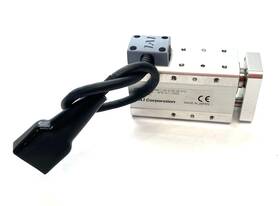
( Brand: Iai Corporation ), ( Manufacturer Part Number: RCA2-GS4NA-I-20-2-30-A3-X10 ), ( Type: Mini Rod Type Robo Cylinder 34mm Width ), ( Country Of Origin: Japan )
Review IAI CORPORATION Corp Mini Rod Type Robo Cylinder Width
The **IAI RCA2-GS4NA-I-20-2-30-A3-X10 Mini Rod Robo Cylinder (34mm)** is a compact yet highly versatile pneumatic actuator designed for precision automation in industrial, medical, and robotic applications where space efficiency and reliability are paramount. This miniature cylinder belongs to the Robo Cylinder series, engineered to deliver smooth, repeatable motion with minimal friction, making it ideal for integration into compact machinery, automated assembly lines, or delicate handling systems. With an outer diameter of just 34mm, it offers an impressive power-to-size ratio, accommodating a stroke length of 20mm while maintaining a robust internal structure that ensures durability under frequent cycling. The **GS4NA** designation signifies a double-acting design with a soft-start feature, allowing for controlled acceleration and deceleration to reduce mechanical stress and extend the life of both the cylinder and connected components. The **I-20-2-30** specification denotes a 20mm stroke, a 20mm bore, and a 30mm rod diameter, providing a balanced force output suitable for applications requiring moderate to light loads, such as clamping, positioning, or indexing tasks. The **A3** variant incorporates a sealed, corrosion-resistant construction, making it resistant to dust, moisture, and mild chemical exposure, which is critical for environments where cleanliness and longevity are non-negotiable. Additionally, the **X10** designation indicates a high-performance, low-friction piston rod with a cross-wound design, reducing wear and tear while enhancing responsiveness. This cylinder is compatible with standard pneumatic fittings, including M5 or M8 ports, and can be easily integrated into existing systems with minimal modifications. Whether deployed in a medical device for precise sample handling, a robotic arm for delicate part manipulation, or an automated testing rig for repeatable motion control, the RCA2-GS4NA-I-20-2-30-A3-X10 excels in delivering consistent, high-speed performance in confined spaces. Its modular design also allows for customization, such as the addition of position sensors or magnetic feedback systems, further expanding its utility in advanced automation setups.
### **Pros and Cons of the IAI RCA2-GS4NA-I-20-2-30-A3-X10 Mini Rod Robotic Cylinder (34mm)**
#### **Pros:**1. **Compact Size and Lightweight Design** The 34mm diameter makes it ideal for applications with limited space, such as small robots, drones, or portable automation systems. Its miniaturized form factor allows for integration into tight mechanical designs without excessive bulk.
2. **High Precision and Repeatability** As a robotic cylinder, it is designed for precise linear motion control, which is essential in applications requiring accurate positioning, such as pick-and-place systems, automated assembly, or medical devices.
3. **Modular and Customizable** The product appears to be part of a series that supports various configurations (e.g., stroke lengths, mounting options, and control interfaces). This modularity allows engineers to tailor the cylinder to specific application needs without major redesigns.
4. **Suitable for Automation and Robotics** The "Robo" designation suggests it is optimized for robotic applications, offering smooth operation, low friction, and compatibility with control systems (e.g., PLCs, motion controllers, or ROS-based systems). This makes it a strong candidate for collaborative robots (cobots) or industrial automation tasks.
5. **Potential for High Speed and Acceleration** Miniature cylinders like this are often designed for rapid movement, which can improve throughput in automated processes. The 20mm stroke (or other variants) may allow for quick cycles, depending on the load and control settings.
6. **Compatibility with Advanced Control Systems** The "A3" and "X10" designations likely refer to specific control interfaces or communication protocols (e.g., analog or digital signals, CANbus, or Ethernet). This suggests it can integrate seamlessly with modern industrial or research-grade control systems, enhancing flexibility in programming and monitoring.
7. **Durability for Repeated Use** If built to industrial standards, the cylinder should withstand frequent cycling without excessive wear, making it reliable for continuous operation in automated environments.
8. **Potential for Low Power Consumption** Smaller actuators often consume less energy than larger counterparts, which can be beneficial for battery-powered or energy-efficient systems.
---
#### **Cons:**1. **Limited Load Capacity** At 34mm, the cylinder s force output will be significantly lower than larger pneumatic or hydraulic cylinders. This may restrict its use to applications with light to moderate loads (e.g., moving small parts, delicate materials, or lightweight tools). For heavy-duty tasks, a larger actuator may be necessary.
2. **Higher Cost Relative to Size** Miniature precision components, especially those designed for robotic or automated systems, often come at a premium compared to standard pneumatic or hydraulic cylinders. The cost per unit may be prohibitive for low-budget projects or bulk applications.
3. **Potential for Higher Maintenance Requirements** Smaller actuators can have tighter tolerances, which may make them more sensitive to contamination (e.g., dust, debris, or lubricant breakdown). This could require more frequent cleaning, lubrication, or calibration to maintain performance.
4. **Limited Stroke Length Options** The 20mm stroke (or similar) may be insufficient for applications requiring longer linear motion. If the application demands a greater range of movement, multiple cylinders or a different actuator type (e.g., a longer-stroke pneumatic cylinder) may be needed.
5. **Integration Challenges** While compact, the cylinder may require custom mounting solutions or additional support structures to ensure stability and alignment in the mechanical system. This could add complexity to the design phase.
6. **Dependence on External Power and Control** Like most robotic actuators, this cylinder will require a power source (e.g., compressed air, electric motor, or hydraulic pump) and a control system (e.g., PLC, microcontroller). The setup may involve additional components (e.g., regulators, sensors, or drivers), increasing system complexity and cost.
7. **Potential for Higher Noise or Vibration** Miniature pneumatic or electric actuators can sometimes produce more noise or vibration than larger counterparts, depending on the design. This may be a consideration in sensitive environments (e.g., medical, laboratory, or precision manufacturing).
8. **Limited Availability of Spare Parts or Support** As a specialized component, finding replacement parts or technical support may be more difficult than with off-the-shelf actuators. Ensuring long-term availability could be a concern for large-scale deployments.
9. **Learning Curve for Implementation** Integrating a high-precision robotic cylinder into a system may require expertise in motion control, programming, or mechanical design. Teams unfamiliar with such components may face challenges during setup or troubleshooting.
10. **Potential for Higher Failure Rates in Harsh Environments** While durable, miniature actuators may be less resilient to extreme temperatures, humidity, or chemical exposure compared to larger industrial actuators. Environmental considerations should be carefully evaluated before deployment.
---
### **Conclusion:**The **IAI RCA2-GS4NA-I-20-2-30-A3-X10 Mini Rod Robotic Cylinder (34mm)** is a highly specialized actuator well-suited for applications requiring **precision, compactness, and integration with robotic or automated systems**. Its advantages lie in its **small footprint, modularity, and compatibility with advanced control systems**, making it ideal for **research, prototyping, medical devices, or collaborative robotics** where space and accuracy are critical.
However, its **limited load capacity, higher cost, and potential maintenance challenges** may make it impractical for **heavy-duty industrial tasks, large-scale automation, or applications with tight budgets**. Additionally, the **need for external power and control systems** adds complexity to the overall setup.
### **Recommendation:** - **Buy if:**- You are working on a **precision automation project** (e.g., pick-and-place, micro-assembly, or medical robotics) where space is limited.
- Your application requires **integration with a robotic arm, PLC, or motion control system** and benefits from the cylinder s compact size and modularity.
- You are willing to invest in a **high-quality, specialized actuator** for applications where standard pneumatic or hydraulic cylinders would not suffice.
- The **load requirements are light to moderate**, and the stroke length meets your needs.
- **Avoid if:**- Your project involves **heavy loads, long strokes, or high-force applications**, where a larger actuator would be more appropriate.
- You are operating in a **highly cost-sensitive environment** where the premium price of the cylinder could be better allocated elsewhere.
- Your team lacks **experience with robotic actuators**, as integration may require additional expertise or support.
- The **operational environment is harsh** (e.g., extreme temperatures, high contamination), as this could reduce the cylinder s lifespan or performance.
For most **industrial automation tasks**, a standard pneumatic or electric cylinder may be more cost-effective and robust. However, for **cutting-edge robotic applications where precision and miniaturization are paramount**, this cylinder represents a strong choice. Always **test prototypes** and **evaluate long-term reliability** before committing to large-scale deployment.
Details:
Shipping Services. IAI Corp RCA2-GS4NA-I-20-2-30-A3-X10 Mini Rod Type ROBO Cylinder 34MM width . 4-W4J-115481-JL-ZY.
part #: 34mm prices
- $549.99-$999.99
specifications linactuat:
- brand: Iai Corporation
- mpn: Rca2-gs4na-i-20-2-30-a3-x10
- type: Mini Rod Type Robo Cylinder 34mm Width
- country of origin: Japan
shipping linactuat:
- class: Standard, Expedited, One-day
- transit: 2-5 Days
- service: UPS Ground, USPS Priority Mail, UPS Next Day Air
- carrier: UPS, USPS
- cost: $0.00
- type: Calculated
general linactuat:
- condition: Used
- Industrial Automation Motion Controls > Rotary Linear Motion > Linear Actuators
returns linactuat:
- time: 30 Days
- paid by: Seller
- policy: Returns Accepted
- method: Money back
offer linactuat:
- availability: In Stock
- best offers: True
- sold: 0
- started: April 23, 2026
- quantity: 4
- options: Ship-to-home
seller linactuat:
- # reviews: 28843
- city: Baroda, Michigan
- rating: 100.0%
payments linactuat:
- credit card: Diners-club
- other
- wallet: Apple-pay
Iai Corporation 34MM Is Similar To:
- Ds-s5l-200 Iai Corporation 200 Mm (36.7% similar) ...(September 30th, 2017)
- Ds-sa6m-300-g Iai Corporation Robo Cylinder (44.6% similar) Pulled from decommissioned automation equipment...(January 31st, 2018)
- Is-l-x-mx-20-400-1200-ll-w-t1-inc-sp Ispa-mxm-a-100-10-600-t1-aq Is-m-y-m-20-200-600-l-t1-inc Iai Corporation X Y Axis Cartesian Robot (24.4% similar) Otherwise industrial parts r us inc. Next day service is available if order is placed by 3/3 0 PO. Industrial parts r us, inc. The x axis runs 600MM long and the y axis runs 1200MM long. The z axis is driven by an MC CE1832 H0578 175 pneumatic cylinder. This is not always the case but has happened ...(December 8th, 2016)
- Ispa-mxm-a-100-10-600-t1-aq Iai Corporation X Y Axis Cartesian Robot Assembly (32.9% similar) And under ship USPS priority mail. Next day service is available if order is placed by 3/3 0 PO. This is not always the case but has happened in the past. Industrial parts r us, inc. Otherwise industrial parts r us inc. Larger packages up to 150 lbs. All smaller items 70 lbs. For emergency orders ...(July 22nd, 2016)
- Rcp2-ss-i-pm-3-300-p1-n Iai New Robo Cylinder Stroke 300mm 11.8 With Motor (34.8% similar) 8, with motor. Messaging though messages. Our cut of time for shipping an item is 3/4 5PM ct...(November 16th, 2016)
- Rcp2-ra4c-i-42p-5-250 Rcp2-ra4c-i-42p-5-250-p1-n Iai Robo Cylinder Slider Type Steel Base Electric Actuator (34% similar) Sell as is could not accept return. Please for discussion of shipping details. Iai robo cylinder RCP2 RA4C I 42P p1 n slider type steel base electric actuator new in original box shipping details due to each item's and each customer's shipping needs are not same, shipping costs and methods will vary...(August 3rd, 2016)
- Rcp2-sa6c-i-42p-12-550-p1-r05 Iai Robo Cylinder Pulse Motor 550mm New (46.2% similar) Please for discussion of shipping details. Robo cylinder RCP2 SA6C I 42P p1 R05 pulse motor 550MM new in the original box shipping details due to each item's and each customer's shipping needs are not same, shipping costs and methods will vary by item and customer...(July 17th, 2016)
- Ispa-l2m-i-200-5-400-t2-b-eu-sp Iai Corporation Actuator (28% similar) Photos of actual item for sale. Unit has scuffs and scratches from previous use handling. Iai Corporation ISPA-L2M-I T2-B-EU-SP actuator was pulled from a fully functional environment. Unit is on hand and ready to ship. Includes unit only...(June 5th, 2018)
- Ispa-mxm-a-100-10-800-t1 Iai Corporation Cartesian Robot Ispa Precision Linear Actuators 646412777910 (33% similar) View our complete range of products. Unless special packaging or shipping arrangements are requested next day air orders need to be placed before 3:00 PO. Please make checks payable to industrial parts r us inc. Mail checks to: industrial parts r us inc. Delivery is needed. Orders placed before 12:...(March 13th, 2018)
- Knox0200722-rcs-ra55-i-100-gd-l-200-x10-b Iai Corp Robocylinder New No Box (27.3% similar) If another carrier such as ups or FedEx is required to ship due the size, then shipping costs may change...(October 6th, 2018)
- Pcon-ca-42pwai-ep-0-0 Iai Corporation Guaranteed Position Controller Actuator (35.4% similar) For USA and Canada. Guaranteed - Iai Corporation PCON-CA-42PWAI-EP-0-0 position controller actuator as shown in pictures money back guarantee. Sold as 100 working. All of our electronic parts are guaranteed and come with a 60 day replacement warranty. There are no issues to note. Fast free shipping...(March 25th, 2018)