AUTOMATION DIRECT TDR-MX500BD Incremental Encoder
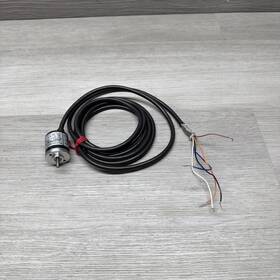
( Brand: Automation Direct ), ( Manufacturer Part Number: TDR-MX500BD )
Review AUTOMATION DIRECT Incremental Encoder Untested
The **TD-RMX500BD Incremental Encoder** is a high-performance, robust industrial encoder designed to deliver exceptional precision, reliability, and versatility in motion control applications. Part of the TD-R series, this encoder combines cutting-edge technology with a compact, ruggedized construction to meet the demanding requirements of automation systems in manufacturing, robotics, CNC machining, and material handling. Built with a **500-line incremental resolution**, it provides fine positional feedback with a maximum count of 500 pulses per revolution, enabling smooth and accurate motion control while maintaining high-speed performance. The encoder features a **bipolar output signal** (A/B phases) with an optional **index pulse (Z-phase)**, allowing for precise zero-position detection and enhanced synchronization in multi-axis systems. Its **high-impact, corrosion-resistant housing** is constructed from durable materials, ensuring resistance to dust, moisture, and harsh environmental conditions, making it ideal for use in automated assembly lines, packaging machinery, or outdoor industrial applications where reliability is paramount.
The **TD-RMX500BD** incorporates a **Hall-effect sensor technology**, which guarantees long-term stability, minimal wear, and superior noise immunity, even in the presence of electromagnetic interference (EMI). This makes it well-suited for applications where signal integrity is critical, such as in high-speed servo drives or closed-loop feedback systems. The encoder s **sealed, lubricated bearings** and **IP67-rated protection** ensure smooth operation and longevity, reducing maintenance downtime and operational costs. With a **wide operating temperature range** of -20 C to 85 C, it performs consistently across diverse industrial environments, from cold storage facilities to high-temperature processing plants. Additionally, its **compact, modular design** allows for easy integration into existing systems, whether mounted on shafts, flanges, or directly onto motors via a variety of connection options, including **M12, M18, or custom shaft couplings**.
For enhanced flexibility, the **TD-RMX500BD** supports multiple communication interfaces, including **TTL, RS422, or differential signals**, depending on the application s needs. This adaptability ensures seamless compatibility with a wide range of PLCs, motion controllers, and industrial automation platforms. The encoder s **low-profile construction** minimizes space constraints while maintaining structural integrity, making it an excellent choice for applications where footprint efficiency is a priority. Whether used in **linear motion systems, conveyor belts, or precision positioning stages**, this encoder delivers consistent, high-resolution feedback to optimize system performance, reduce errors, and improve overall productivity. With its blend of **precision engineering, durability, and ease of integration**, the **TD-RMX500BD Incremental Encoder** stands as a reliable workhorse in modern automation, empowering engineers to achieve tighter process control and higher operational efficiency.
**Pros and Cons of buying a Automation TDR-MX500BD Incremental Encoder**
The Automation TDR-MX500BD is an incremental encoder designed for precise motion control applications, such as CNC machines, robotics, and automated manufacturing systems. Below is a detailed analysis of its advantages and disadvantages.
### **Pros**
1. **High Precision and Resolution**
The TDR-MX500BD offers a high-resolution incremental output (typically 1,000 or more pulses per revolution), which ensures accurate position feedback. This is critical for applications requiring fine control, such as high-speed machining or precise linear motion.
2. **Rugged and Reliable Construction**
It is built with durable materials, including stainless steel shafts and sealed bearings, making it resistant to dust, moisture, and mechanical stress. This enhances its longevity in industrial environments where reliability is essential.
3. **Wide Range of Mounting Options**
The encoder supports multiple mounting styles, including hollow shaft, solid shaft, and flange mounting, allowing flexibility in integration with different types of motors and mechanical systems.
4. **Compatibility with Common Control Systems**
It is designed to work seamlessly with PLCs, motion controllers, and servo drives commonly used in automation. The incremental output (A/B phase signals) is widely supported, reducing the need for additional interfaces.
5. **Cost-Effective for Mid-Range Applications**
Compared to high-end absolute encoders or more advanced incremental encoders, the TDR-MX500BD provides a balance between performance and cost, making it suitable for budget-conscious projects without sacrificing too much accuracy.
6. **Low Maintenance Requirements**
Due to its sealed design and robust construction, the encoder requires minimal maintenance, reducing downtime and operational costs over its lifespan.
7. **Backlash-Free Operation**
Incremental encoders like this one eliminate mechanical backlash issues that can arise with traditional limit switches or mechanical counters, improving system accuracy.
8. **Easy Installation and Calibration**
The encoder is designed for straightforward installation, often requiring minimal calibration once mounted. This reduces setup time and potential errors during commissioning.
---
### **Cons**
1. **No Absolute Positioning**
Unlike absolute encoders, the TDR-MX500BD does not provide a fixed reference point upon power-up. This means the system must perform a homing or reference move at startup to determine the absolute position, which can introduce delays and potential errors if not handled properly.
2. **Limited Resolution Compared to Absolute Encoders**
While it offers high incremental resolution, it cannot match the single-point accuracy of absolute encoders, which provide a direct digital representation of position without the need for homing.
3. **Sensitivity to Electrical Noise**
Incremental encoders rely on precise signal detection, and in noisy environments (e.g., near strong electromagnetic fields or poor wiring), the A/B phase signals may become corrupted, leading to miscounting or loss of position data. Shielded cables and proper grounding are often required.
4. **Dependence on System Homing Routines**
The lack of absolute positioning means the system must include a homing procedure to establish a reference point. This adds complexity to the control software and can introduce additional wear on mechanical components during homing cycles.
5. **Potential for Signal Loss During Power Interruptions**
If power is lost, the encoder will lose its incremental count, requiring a full homing sequence upon restart. This can be problematic in applications where quick recovery is critical.
6. **Limited Customization Options**
The TDR-MX500BD is a standard product with fixed specifications (e.g., resolution, output type). Users requiring highly customized features (e.g., unique mounting dimensions or specialized signal outputs) may need to explore alternative solutions.
7. **Potential for Signal Skew in High-Speed Applications**
At very high speeds, the incremental signals (A/B phases) may experience skew or phase shifts, which can lead to misinterpretation of position data if not properly filtered or compensated for in the control system.
---
### **Conclusion**
The Automation TDR-MX500BD incremental encoder is a robust and cost-effective choice for applications requiring precise incremental position feedback without the need for absolute positioning. Its high resolution, durability, and compatibility with standard control systems make it well-suited for a wide range of industrial automation tasks, particularly where homing routines can be reliably implemented.
However, its lack of absolute positioning and sensitivity to electrical noise may pose challenges in certain applications, such as those requiring immediate position recovery after power loss or operating in highly electromagnetic environments. Users must carefully consider whether the trade-offs align with their specific requirements.
### **Recommendation**
**Buy the TDR-MX500BD if:**- Your application requires incremental position feedback with high resolution and does not need absolute positioning.
- You are working in a controlled environment where homing routines can be reliably executed.
- Cost efficiency and durability are priorities, and you can mitigate potential noise issues with proper shielding and grounding.
- The encoder s mounting options and compatibility with your existing control system are suitable.
**Avoid the TDR-MX500BD if:**- Absolute positioning is critical, and you cannot afford the time or mechanical wear associated with homing routines.
- Your environment is highly prone to electrical noise or electromagnetic interference, and you lack the infrastructure to mitigate it.
- You require highly customized features or resolutions that exceed the encoder s standard specifications.
- Your application demands immediate position recovery after power loss without manual intervention.
**Alternative Considerations:**- If absolute positioning is required, consider an absolute encoder (e.g., SSI or parallel interface) for single-point accuracy.
- For applications with extreme noise or high-speed requirements, explore encoders with enhanced signal conditioning or optical isolation.
- If budget allows, evaluate higher-end incremental encoders with additional features (e.g., built-in index pulses or enhanced noise immunity).
Details:
Automation Direct TDR-MX500BD Incremental Encoder. Used and untested.
part #: tdrmx500bd price
- $59.99
specifications linactuat:
- brand: Automation Direct
- mpn: Tdr-mx500bd
offer linactuat:
- quantity: 1
- started: May 16, 2026
- sold: 0
- availability: In Stock
- options: Ship-to-home
- best offers: True
seller linactuat:
- rating: 100.0%
- # reviews: 3991
- city: Oldtown, Idaho
general linactuat:
- Industrial Automation Motion Controls > Rotary Linear Motion > Linear Encoders
- condition: Used
returns linactuat:
- method: Money back
- time: 30 Days
- paid by: Seller
- policy: Returns Accepted
shipping linactuat:
- service: USPS Ground Advantage
- type: Fixed
- transit: 4-7 Days
- class: Standard
- carrier: USPS
- cost: $0.00
payments linactuat:
- credit card: Mastercard
- other
- wallet: Paypal
Automation Direct TDR-MX500BD Is Similar To:
- 126322 Brooks Automation Linear Drive Track Controller For Wafer Handling Robot Encoder (38.6% similar) The controller with cables looks like it's brand new, and the linear track is in excellent condition and could be new too, but since I'm not 100 certain I'm selling it as used. Packaging condition N/A model part number the following numbers are from the item or box label brooks Automation P/N other ...(August 10th, 2016)
- Knox60013596-a24050dn Automation Direct Nitra Air Cylinder New In Original Package (40% similar) If another carrier such as ups or FedEx is required to ship due the size, then shipping costs may change...(September 8th, 2018)
- Knox60013784-a24050dn Automation Direct Air Cylinder New No Box (44.6% similar) If another carrier such as ups or FedEx is required to ship due the size, then shipping costs may change...(October 8th, 2018)
- Knox60013790-a24050dn Automation Direct Air Cylinder New In Original Package (41.8% similar) If another carrier such as ups or FedEx is required to ship due the size, then shipping costs may change...(October 8th, 2018)
- Mros90012112-ta58-1000-gye-id Deutschmann Automation Encoder New In Box (31% similar) If another carrier such as ups or FedEx is required to ship due the size, then shipping costs may change...(June 17th, 2018)
- Mros90012114-v1130-17-01000-i485-x004 Deutschmann Automation Encoder Operator New In Box (30.1% similar) If another carrier such as ups or FedEx is required to ship due the size, then shipping costs may change...(June 17th, 2018)
- Ab Allen Bradley Rockwell Automation 845-fc-b-b One Flexible Encoder Coupling 3 8 Inch High Speed New (35.2% similar) This offer is for one ab Allen Bradley 845-FC-B-B flexible encoder coupling 3/8 high speed in very good condition - one package opened identical to sealed packages. Pictures: pictures are taken of the actual item for sale. If there are multiple items, pictures taken of a representative sample. I am ...(October 17th, 2023)
- Deutschmann Automation Tn65-1000-2-him485-e-n Encoder (46.8% similar) Part #: Automation TN65-1000-2-HIM485-E-N for sale...(July 31st, 2024)
- Automation Direct Koyo Trd-n60-rzwd Incremental Rotary Encoder 5-30vdc 60ppr (67.2% similar) Specifications: model #: TRD-N60-RZWD. Automation Direct kayo. Encoder resolution: 60PPR. This is a surplus item. Speed rating: 3000RPM. If you do not have an account no worries. voltage rating: 4.75-30VDC. Incremental rotary encoder...(October 15th, 2024)
- Hohner Automation 4-008-61-0107 Encoder Usip (49% similar) 2-YEAR MRI shield protection plan included. Special instructions. Honer Automation 4-008-61-0107 encoder. Most items are in stock when they listed. Honer Automation 4-008-61-0107 encoder manufactured by honer Automation. Manufacturer part number: 4-008-61-0107. The product must be the original item ...(October 25th, 2025)
- Automation Direct Stp-le23-3h12ann Stple233h12ann Used (45.6% similar) Packaging and handling: items are safely eds packaged in custom shipping cartons for protection. Sells new and surplus product develops channels to purchase such. Automation Direct STP-LE23-3H12ANN / STPLE233H12ANN used sure step stepper motor linear actuator, external nut, Norma 23 frame, IP40, ...(January 27th, 2026)