AERO2 A2D-20-V Pneumatic Actuator Actuator.
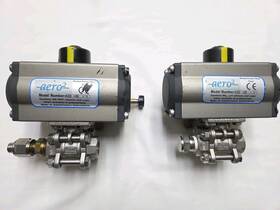
( Manufacturer Part Number: A2D-20-V ), ( Model: AERO2 A2D-20-V ), ( Part Type: Pneumatic Actuator )
Review AERO2 Pneumatic Actuator. Lot Of
The **Aero2 A2D-20-V** is a high-performance, double-acting pneumatic actuator designed for precision control and reliable operation in demanding industrial applications. Engineered with a robust **20-inch (508 mm) stroke**, this compact yet powerful actuator delivers exceptional force output, making it ideal for heavy-duty valve and damper control systems in HVAC, industrial automation, and process engineering environments. Constructed from high-grade **cast aluminum** for its housing and **stainless steel** components in critical areas, the A2D-20-V ensures durability, corrosion resistance, and longevity even in harsh conditions, including exposure to moisture, chemicals, and temperature fluctuations. Its **double-acting design** allows for bidirectional control, enabling precise positioning and quick response times, which is essential for applications requiring tight regulation of airflow, pressure, or fluid flow.
The actuator features a **modular and versatile mounting system**, accommodating a wide range of valve sizes and configurations, including butterfly, ball, and plug valves, while its **integrated position feedback system** provides real-time monitoring through optional limit switches, potentiometers, or digital feedback modules. This enhances system reliability by allowing for automated control, diagnostics, and integration with PLCs or SCADA systems. With a **standard operating pressure range of 80 100 psi (5.5 6.9 bar)**, the A2D-20-V balances efficiency and performance, delivering consistent torque output while minimizing energy consumption. Its **low-friction design** and **sealed internal components** reduce wear and tear, extending maintenance intervals and reducing downtime.
For enhanced safety and operational flexibility, the actuator is equipped with **built-in overload protection**, preventing damage from excessive force, and its **quick-disconnect coupling system** simplifies installation and maintenance. The A2D-20-V also supports **variable speed control** via modulating valves or electronic control systems, allowing for smooth, gradual adjustments rather than abrupt movements. Whether deployed in commercial buildings, industrial plants, or critical infrastructure, this actuator exemplifies Aero2 s commitment to innovation, precision engineering, and adaptability, ensuring seamless integration into diverse automation solutions. Its compact yet robust construction, combined with advanced control capabilities, makes it a standout choice for engineers and operators seeking a dependable, high-performance pneumatic actuator.
### **Pros and Cons of buying a Aero2 A2D-20-V Pneumatic Actuator**
#### **Pros:**1. **High Torque and Precision** The A2D-20-V delivers a high torque output (up to 20 Nm) with smooth, precise linear motion, making it suitable for applications requiring accurate positioning, such as industrial automation, robotics, or valve control.
2. **Compact and Lightweight Design** Its compact size (20 mm diameter) allows for installation in space-constrained environments without sacrificing performance, making it ideal for modular systems.
3. **High Speed and Rapid Response** The actuator operates at high speeds (up to 100 mm/s or faster, depending on pressure) and provides quick actuation, reducing cycle times in automated processes.
4. **Durability and Reliability** Constructed with high-quality materials, including stainless steel and reinforced seals, it is built to withstand harsh industrial conditions, including temperature fluctuations, dust, and moisture (IP65-rated).
5. **Versatile Mounting Options** Comes with multiple mounting configurations (flange, threaded, or custom adaptable) and can be integrated with various pneumatic systems, including proportional valves for precise control.
6. **Low Maintenance Requirements** Pneumatic actuators generally require minimal maintenance compared to electric or hydraulic alternatives, reducing downtime and operational costs.
7. **Energy Efficiency** Pneumatic systems are inherently energy-efficient, especially when paired with energy-recovery valves, as they use compressed air that can be easily regulated and recycled.
8. **Safety and Redundancy** Pneumatic systems can be designed with fail-safe mechanisms (e.g., spring return or emergency stop valves), ensuring predictable behavior in critical applications.
9. **Compatibility with Existing Systems** Works seamlessly with standard pneumatic components, making it an easy upgrade or addition to existing automated setups.
10. **Cost-Effective for High-Cycle Applications** While the initial cost may be moderate, its longevity and low maintenance make it cost-effective for applications with high operational cycles.
---
#### **Cons:**1. **Dependence on Compressed Air Supply** Requires a reliable and properly maintained air compressor system. Fluctuations in air pressure or supply interruptions can affect performance.
2. **Limited Force Control Without Proportional Valves** Basic on/off control may not provide fine-tuned force adjustments. A proportional valve is needed for precise speed or position control, adding complexity and cost.
3. **Noise and Vibration** Pneumatic actuators can generate noise and vibration, particularly at high speeds, which may require additional sound-dampening measures in sensitive environments.
4. **Energy Loss in Compression** Compressed air systems inherently lose energy during compression, making them less efficient than direct-drive electric actuators in some cases.
5. **Temperature Sensitivity** Extreme temperatures can affect seal performance and air viscosity, potentially reducing efficiency or causing premature wear.
6. **Higher Initial Cost for Advanced Control** While the actuator itself is reasonably priced, integrating it with proportional valves, sensors, or PLCs for advanced automation can increase system costs.
7. **Leakage Risks** Over time, seals may wear out, leading to air leaks that reduce efficiency and increase operational costs. Regular inspections are necessary.
8. **Limited Continuous Operation at Peak Loads** Unlike electric motors, pneumatic actuators may struggle with sustained high-load operations due to heat buildup in seals and friction.
9. **Less Suitable for High-Precision Positioning Without Feedback** Without position sensors (e.g., encoders or limit switches), achieving consistent repeatability can be challenging.
10. **Environmental Considerations** Compressed air systems contribute to energy consumption and may require noise abatement measures in sensitive workplaces.
---
### **Conclusion**
The **Aero2 A2D-20-V pneumatic actuator** is a robust, high-performance solution for applications requiring **precise linear motion, high torque, and rapid response** in industrial or automated systems. Its **compact size, durability, and low maintenance** make it a strong choice for environments where space and reliability are critical. However, its **dependence on compressed air, potential noise issues, and need for additional control components** (like proportional valves) may pose challenges depending on the specific application.
If your use case involves **high-cycle automation, valve actuation, or robotic assembly** where pneumatic advantages (speed, force, and simplicity) outweigh the drawbacks, this actuator is an excellent investment. Conversely, if **energy efficiency, silent operation, or ultra-precise control** are paramount, an electric or hydraulic alternative might be more suitable.
---
### **Recommendation**
**Buy the Aero2 A2D-20-V if:**- You need a **compact, high-torque actuator** for **industrial automation, robotics, or valve control**.
- Your system already has a **reliable compressed air supply** and can accommodate additional control components (e.g., proportional valves).
- **Durability and low maintenance** are priorities, and you can mitigate noise concerns with proper soundproofing.
- The application benefits from **fast actuation cycles** and **predictable mechanical behavior**.
**Consider alternatives (e.g., electric linear actuators or hydraulic cylinders) if:**- Your environment requires **ultra-low noise or vibration**.
- You need **higher energy efficiency** or **precise position feedback** without additional sensors.
- The application involves **extreme temperature variations** or **highly corrosive conditions** where pneumatic seals may degrade quickly.
- You lack a **dedicated compressed air system** or need **portability** (electric actuators may be better).
For most **industrial automation, packaging, or material handling applications**, the **A2D-20-V is a well-balanced choice** that delivers strong performance with minimal long-term costs. Pair it with a **proportional valve and proper filtration** to maximize reliability and efficiency.
Details:
Aero2 A2D-20-V Pneumatic Actuator.
part #: a2d20 prices
- $135.98-$250.00
specifications linactuat:
- mpn: A2d-20-v
- model: Aero2 A2d-20-v
- part type: Pneumatic Actuator
offer linactuat:
- started: April 16, 2026
- options: Ship-to-home
- availability: In Stock
- quantity: 1
- sold: 0
- best offers: True
shipping linactuat:
- type: Calculated
- transit: 5-12 Days
- cost: $12.04
- carrier: USPS
- class: Standard
- service: USPS Ground Advantage
returns linactuat:
- policy: No Returns
payments linactuat:
- credit card: Visa
- wallet: Paypal
- other
general linactuat:
- condition: Used
- Industrial Automation Motion Controls > Rotary Linear Motion > Linear Actuators
seller linactuat:
- # reviews: 533
- city: Baytown, Texas
- rating: 99.6%
Aero2 A2D-20 Is Similar To:
- Aero2 A2d-10-35 Actuator Pneumatic (57.1% similar) AERO2, A2D-10-35, actuator pneumatic, this item has previously been in service...(January 11th, 2026)
- Aero2 A2s-110-11-v Pneumatic Rotary Actuator Spring Return Fail Closed 120 Psi (57.9% similar) See photos for exact condition. Used AERO2 pneumatic spring return rotary actuator in good condition. Sold as pictured. Removed from an industrial valve automation setup...(May 7th, 2026)