NEWMARK AUTOMATION NLS4-2-10-06P Motorized Linear Lin Step C200577 Motor Driver
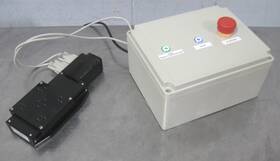
( Brand: Newmark Automation ), ( Manufacturer Part Number: NLS4-2-10-06P ), ( Part Type: Linear Motor Driver )
Review NEWMARK AUTOMATION Motorized Linear Stage Lin Step Motor Driver
The **Newmark Automation NLS4-2-10-06P (C200577) Motorized Linear Stepper Motor Driver** is a high-performance, precision-engineered solution designed to deliver seamless motion control for demanding industrial and automation applications. This compact yet robust driver is engineered to interface directly with linear stepper motors, offering unmatched accuracy, reliability, and efficiency in converting electrical pulses into precise linear motion. Built with a robust 2-phase hybrid stepper motor interface, the NLS4-2-10-06P ensures smooth, jitter-free operation with minimal backlash, making it ideal for applications requiring sub-micron positioning, such as CNC machining, pick-and-place systems, medical instrumentation, or automated assembly lines. The driver s integrated microstepping capability capable of up to 1/16th microstepping enables ultra-fine motion control, reducing vibration and enhancing overall system performance while minimizing audible noise. With a rated current of 2.0A per phase and a continuous torque output of 0.6 Nm (at 100% duty cycle), this driver is well-suited for medium-duty applications where consistent force and repeatability are critical.
One of the standout features of the NLS4-2-10-06P is its versatile connectivity and compatibility, making it a seamless fit for modern automation environments. The driver supports a wide range of communication protocols, including **RS-232, RS-485, and Ethernet (via optional modules)**, allowing for easy integration with PLCs, CNC controllers, or custom control systems. Its built-in **C200577 firmware** ensures compatibility with Newmark s proprietary motion control software, enabling advanced features such as velocity and acceleration profiling, homing routines, and position feedback via encoder inputs (if paired with an optional encoder module). The driver also includes protective features like **overcurrent, overtemperature, and short-circuit protection**, ensuring long-term reliability and reducing the risk of equipment damage. Its compact, IP65-rated enclosure provides robust protection against dust, moisture, and electromagnetic interference, making it suitable for harsh industrial environments.
For applications requiring even greater precision, the NLS4-2-10-06P can be paired with Newmark s **linear stepper motors**, which are designed for high efficiency, low cogging, and minimal thermal drift. The driver s **PWM current control** optimizes motor performance while minimizing heat generation, extending the lifespan of both the motor and the driver. Additionally, its **slewing mode** allows for rapid acceleration and deceleration, significantly improving throughput in high-speed applications without compromising positional accuracy. Whether deployed in a high-precision inspection system, a robotic arm, or a custom automated conveyor, this driver delivers the precision, durability, and flexibility needed to meet the most exacting motion control requirements. With its blend of advanced features, industrial-grade construction, and seamless integration capabilities, the Newmark Automation NLS4-2-10-06P stands as a reliable workhorse for engineers and automation specialists seeking a turnkey solution for linear motion control.
### **Pros and Cons of buying a Newmark Automation NLS4-2-10-06P (C200577) Motorized Linear Stepper Motor Driver**
#### **Pros**
1. **High Precision and Repeatability** The driver is designed for stepper motor control, which ensures precise positioning and repeatability, ideal for applications requiring exact movements (e.g., CNC machines, automation systems, or laboratory equipment).
2. **Compact and Integrated Design** The motor and driver are combined into a single linear stepper module, reducing installation complexity and saving space compared to separate motor and driver setups.
3. **High Torque and Load Capacity** With a 2-phase hybrid stepper motor (100 oz-in or 7.1 Nm), it can handle moderate to heavy loads, making it suitable for applications like pick-and-place systems or small-scale material handling.
4. **Built-in Microstepping Support** Many stepper drivers support microstepping (e.g., 1/16th or 1/32nd stepping), which improves smoothness and reduces vibration, enhancing performance in applications requiring fine motion control.
5. **Compatibility with Common Control Systems** The driver is likely compatible with standard step/direction interfaces (e.g., parallel or serial stepper drivers) and can be integrated with PLCs, Arduino, or other microcontroller-based systems via appropriate signal conditioning.
6. **Durability and Reliability** Stepper motors are known for their robustness, low maintenance requirements, and long operational lifespan, especially when properly sized for the application.
7. **Cost-Effective for Mid-Range Applications** Compared to servo systems, stepper motor drivers like this one offer a balance between cost and performance, making them a practical choice for budget-conscious projects that don t require closed-loop feedback.
8. **Easy Installation** The integrated design simplifies wiring and mounting, as there s no need to separately connect a motor to a driver via cables or couplings.
---
#### **Cons**
1. **Limited Load Capacity for Heavy Applications** The 100 oz-in (7.1 Nm) torque may be insufficient for high-load applications (e.g., industrial machining, heavy lifting, or high-speed material handling). Oversizing the motor can lead to inefficiency or overheating.
2. **No Closed-Loop Feedback** Unlike servo motors, stepper motors lack encoders or feedback mechanisms. If the motor loses steps (e.g., due to overload or resonance), it cannot recover automatically, potentially causing errors in positioning.
3. **Resonance and Vibration Issues** Stepper motors can experience resonance at certain speeds, leading to vibrations or missed steps. This requires careful tuning of acceleration/deceleration profiles or damping solutions.
4. **Heat Dissipation Requirements** Continuous operation at high currents can generate heat, requiring adequate cooling (e.g., fans or heat sinks) to prevent overheating and motor damage.
5. **Lower Efficiency at High Speeds** Stepper motors are less efficient at very high speeds compared to servo motors, which may limit their use in high-speed automation applications.
6. **Dependence on Proper Sizing** If the motor is undersized for the application, it may stall or overheat. Conversely, oversizing increases cost and inefficiency. Accurate torque and speed calculations are essential.
7. **Limited Customization** Unlike servo systems, stepper motors offer fewer options for dynamic performance tuning (e.g., no built-in PID control for position feedback).
8. **Potential for Step Loss** In dynamic applications (e.g., rapid acceleration or deceleration), step loss can occur if the motor s torque is insufficient, leading to inaccuracies in positioning.
---
### **Conclusion**
The **Newmark Automation NLS4-2-10-06P (C200577) motorized linear stepper module** is a **versatile and cost-effective solution** for applications requiring **precise, repeatable linear motion** within its specified load and speed limits. It excels in **low-to-moderate load applications** where simplicity, reliability, and off-the-shelf integration are priorities such as **CNC milling, 3D printing, automation testing, or small-scale industrial machinery**.
However, it is **not ideal for high-load, high-speed, or closed-loop applications**, where servo systems with encoders would be more appropriate. Users must ensure the motor is **properly sized** for their application to avoid issues like overheating, resonance, or step loss.
---
### **Recommendation**
**Buy this motorized linear stepper driver if:**- You need **precise, low-to-moderate load linear motion** (e.g.,
- Your application does **not require closed-loop feedback** (e.g., no need for real-time position correction).
- You prioritize **simplicity, cost efficiency, and ease of integration** over advanced dynamic performance.
- The operating environment allows for **proper cooling and vibration damping** (e.g., using microstepping and optimized acceleration profiles).
**Avoid this motorized linear stepper if:**- Your application involves **high loads (>100 oz-in), high speeds, or dynamic load changes** that could cause step loss.
- You require **closed-loop feedback** (e.g., for high-precision servo-like control).
- You need **extreme reliability in harsh environments** (e.g., high vibration or temperature fluctuations), where servo motors or brushless DC motors may be more robust.
- Your budget allows for **higher-end alternatives** (e.g., servo motors with encoders) that offer better performance in demanding applications.
**Alternative Considerations:**- For **higher loads or closed-loop control**, evaluate **servo motor systems** (e.g., with encoders and PID feedback).
- For **ultra-high precision or dynamic applications**, consider **brushless DC motors with drivers** or **piezoelectric actuators**.
- If **cost is a major concern**, verify that the motor s specifications (torque, speed, and current) match your application s requirements to avoid undersizing or overspending.
Details:
Approximate overall unpacked dimensions: 11 L x 10 W 7. This Newmark Automation NLS4-2-10-06P Motorized Linear Positioning Stage with Lin Engineering 4118M-06P-09RO Stepper Motor features a Control Box containing an ST-M5045 Micro step Driver, Moron S8VK-S12024 24VDC Power Supply, and Panasonic FP0R-C16CT Unit, as shown. The system powers up, and the stage moves around with buttons are pressed. No software, power cords, or other accessories are included unless stated above.
95020 408 886-3700. However, this is the extent of my testing system, and it being sold as-is. The unpacked weight of this item is 20 pounds.
part #: nls421006p price
- $200.00
specifications linactuat:
- brand: Newmark Automation
- mpn: Nls4-2-10-06p
- part type: Linear Motor Driver
returns linactuat:
- policy: No Returns
general linactuat:
- Industrial Automation Motion Controls > Rotary Linear Motion > Linear Actuators
- condition: For parts or not working
shipping linactuat:
- type: Calculated
- carrier: UPS
- transit: 2-6 Days
- cost: $96.99
- class: Standard
- service: UPS Ground
payments linactuat:
- other
- credit card: Mastercard
- wallet: Google-pay
offer linactuat:
- started: April 16, 2026
- best offers: True
- options: Ship-to-home
- availability: In Stock
- sold: 0
- quantity: 1
seller linactuat:
- city: Gilroy, California
- rating: 100.0%
- # reviews: 52664
Newmark Automation NLS4-2-10-06P Is Similar To:
- Rm-3-510 Newmark Systems Motorized Rotary (35.1% similar) Speed stepper motor: 20 sec 90:1 gear ratio, 40 45:1 REPEATABILITY5 arc-sec bi-directional REPEATABILITY40 arc-sec max load CAPACITY20. 4 kg 45 lbs travel RANGE360 continuous gear RATIO90:1 or 45:1STAGE WEIGHT1. 29 arc-sec 72:1 gear ratio, 250 micro steps ACCURACY70 arc-sec max. Used clean working ...(January 22nd, 2018)
- Rm-3-m17-e1 Newmark Systems High Capacity Rotary Stage Now (32.4% similar) The top bottom mounting surfaces are unharmed, all controls Conn unharmed and it is clean. This offer is for one like new Newmark systems RM-3-M17-E1 high capacity rotary stage. Shipping details: the costs listed are best option within continental us. This features: the factory label is marked: ...(April 29th, 2018)
- Vs-15-1-no Newmark Vertical Lift Stage (31.3% similar) Amazing condition. Vertical lift stage VS-15-1-NO...(June 25th, 2017)
- Newmark Systems Inc Nb8-250-112 Ball Screw Linear Stage Optical Encoder Nema 23 (47.3% similar) Travel range: 250MM. Power cords and power adapters are never included unless specifically mentioned. Motor / encodes option: Norma 23 stepper optical linear encoder. Shipping buyer pays for all shipping costs. Orders are shipped to the cardholders billing address. Interface plate: metric plate. ...(August 25th, 2024)
- Newmark Systems Rm-3-401 Rotary Stage Positioner With Ab Tly-a130t Servo Motor (44% similar) As such, certain specifications may not be accurate and specific options included I know this motor has an encoder but I do if the indexes or a home switch which think would controller for Allen-Bradley. Compact size. This design approach eliminates the use of a dual bearing configuration thus ...(September 14th, 2024)
- Newmark Systems Rm-5d-401 Rotary Stage Positioner With Ab Tly-a220t Servo Motor (43.8% similar) They are guaranteed to work. This is an RM-5D-000 but similar to RM-5D-401 stage with Allen-Bradley TLY-A220T-HJ64AN servo motor encoder. Rotary stage positioned with Allen-Bradley TLY-A220T servo motor encoder, comes what you see in the pictures. The worm gear is reload to minimize the backlash in ...(September 27th, 2024)
- Newmark Nls4-4-16-e1 Precision 4 Inch Travel Linear Translation Stage Lin Step Motor (51.7% similar) Model: NLS4-4-16-E1. This stage is in fair cosmetic condition, with several scratches through the finish on top and one side bracket especially. Comes in non-original packaging. No backlash spring loaded nut. Fitted to z gusset assembly for use as a vertical axis. NLS4-SERIES precision linear ...(December 17th, 2024)
- Newmark Systems Nls4-4-25-mdc Linear Stage Slide Positioner Mls-50-11 And (49.1% similar) There is some oxidation on the tops of screws fastening it together, please look at photos before buying. Units are in good condition and recently came off-line...(February 4th, 2025)
- Newmark Lc-200-22 Systems Linear Stage Model S n 0127 Double (45.3% similar) I have no way to test this. The actuator is suitable for rotary and linear motion an ideal choice businesses industries that require a durable efficient stage. This Newmark systems linear stage model LC-200-22 s/n 0127 is a high-quality and reliable linear actuator made in the USA. Newmark systems ...(February 26th, 2025)
- Newmark Systems Msl-25-11 Linear Stage Slide Positioner Mls2-25-11 25mm Travel (36.9% similar) This item is new and has never been used before, making it an excellent choice for anyone looking a top-quality linear actuator. The brand of this linear actuator is Newmark systems, which known for producing top-notch products. This Newmark systems linear stage slide positioned MLS2-25-11 is a high...(April 9th, 2025)
- Newmark Nls4-8-16 Systems Linear Stage Model Cnc Precision (50% similar) These have been sitting around for several years and planned to use them a project so time sell. Please no Afro or similar addresses. If I understand the part number correctly: these will have 8 inches of travel using a 1/16 lead screw. Will only ship within the USA. Grease has probably dried out at...(April 27th, 2025)